
Why the Timothée Chalamet TikTok Trend Keeps Turning Him Into Someone Else
The Timothée Chalamet TikTok trend is not about uncovering a real secret identity, but about how TikTok repeatedly transforms celebrities into collaborative internet myths. Over the past year, users on the platform have claimed that Chalamet is secretly a U.K. rapper, an underground musician, or an entirely different online persona, and those theories continue to resurface even after being widely debunked.
Rather than fading out, these narratives gain momentum because TikTok rewards interpretation over verification. The platform’s structure encourages viewers to participate in speculation rather than resolve it, which is why the same celebrity can be reimagined again and again without consequence.
How the Timothée Chalamet TikTok Trend Started
The current iteration of the Timothée Chalamet TikTok trend gained traction when creators began stitching interview clips with unrelated music tracks, pointing out perceived similarities in voice, cadence, or demeanor. One widely shared video suggested Chalamet was secretly behind a U.K. rap persona, supported by selective audio comparisons and visual overlays.
A representative example of how this theory circulated can be seen here:
The strength of these videos was never their evidence. It was their format. TikTok thrives on open-ended claims that invite duets, reactions, and counter-theories. Each response reinforces the original video’s reach, regardless of whether viewers believe the premise.
Why TikTok Keeps Recasting Celebrities
The Timothée Chalamet TikTok trend fits into a broader pattern where TikTok users repeatedly assign alternate identities to public figures. The platform does not reward factual certainty as much as it rewards engagement, and speculative narratives consistently outperform definitive explanations.
Chalamet’s public image makes him particularly susceptible to this treatment. His reserved interview style, selective social presence, and introspective film roles are easily reframed as evidence of secrecy. On TikTok, ambiguity is not a weakness. It is a performance advantage.
The Algorithm’s Role in Sustaining the Trend
TikTok measures success through retention signals such as watch time, rewatches, comments, and stitches. Speculative content naturally performs well across all of these metrics. A theory does not need to be correct to be engaging. It only needs to feel plausible enough to invite response.
Creators often soften their claims with language like “this might be a stretch” or “tell me if I’m wrong,” which keeps viewers watching and commenting. TikTok interprets that behavior as positive engagement and distributes the content further, reinforcing the loop.
Celebrity Identity as a TikTok Collaboration
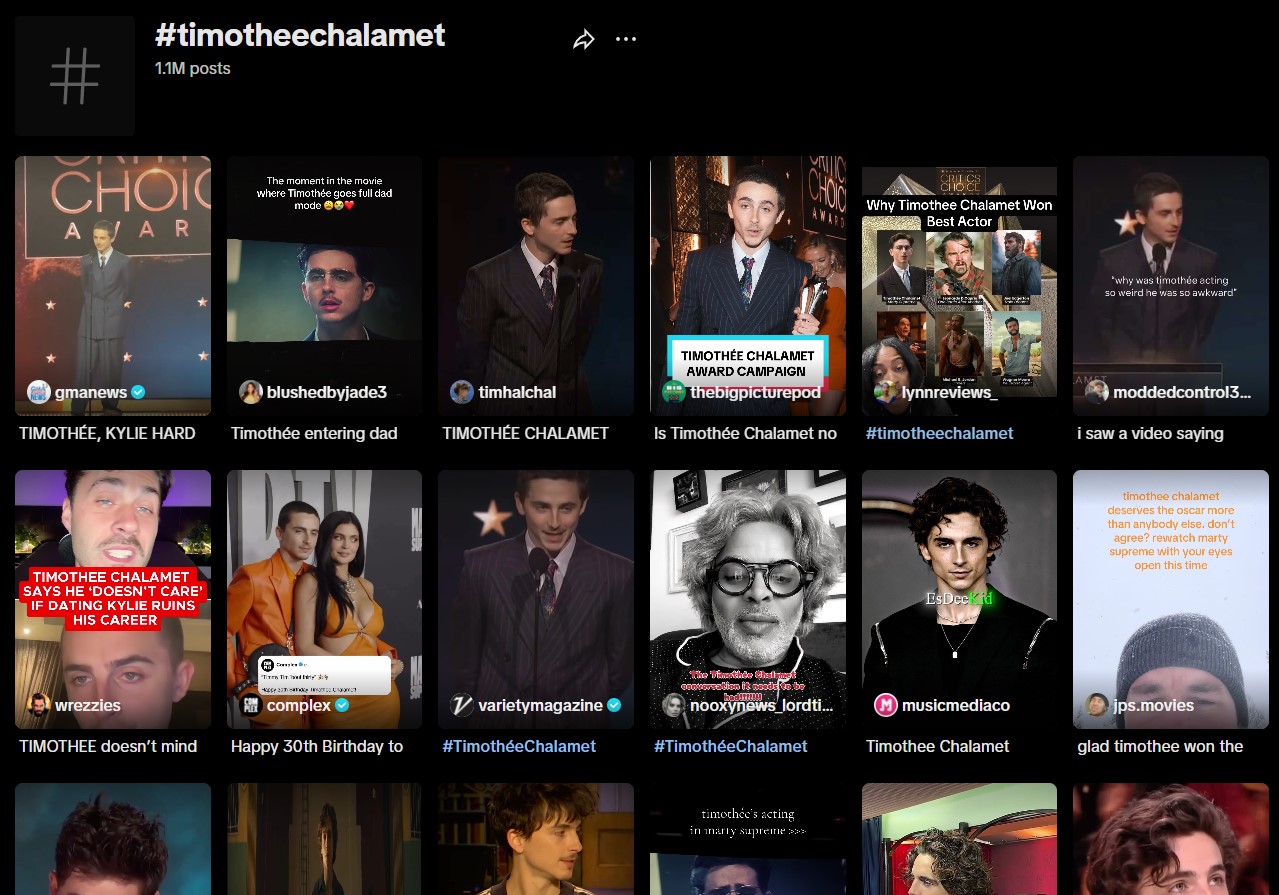
What the Timothée Chalamet TikTok trend ultimately reveals is a shift in how celebrity identity functions on the platform. Celebrities are no longer static figures defined by official narratives. On TikTok, they become collaborative objects shaped by audience interpretation.
This is why debunking rarely ends these trends. Corrective videos close the narrative, while speculative ones keep it open. TikTok consistently favors the latter.
Why This Keeps Happening
TikTok is optimized for discovery, not confirmation. The Timothée Chalamet TikTok trend persists because it gives users the feeling that they are noticing something hidden, even when nothing is actually concealed. The reward is participation, not truth.
As long as TikTok prioritizes interpretive engagement, celebrities with flexible or understated public personas will continue to be reshaped into alternate versions of themselves. Chalamet is not an exception. He is simply one of the most effective examples.
You might Also Like
- TikTok Live Emmys 2026: Incredible Reach, Critical Return

- TikTok’s Critical Mariska Hargitay Emmys 2026: Incredible Buzz

- Chair Challenge TikTok Trend 2026: Incredible, Ultimate Test

- TikTok Community Guidelines 2026: Incredible New Rules, Critical Deadline

- TikTok’s Ultimate NFL Kickoff Game 2026: Incredible Rematch