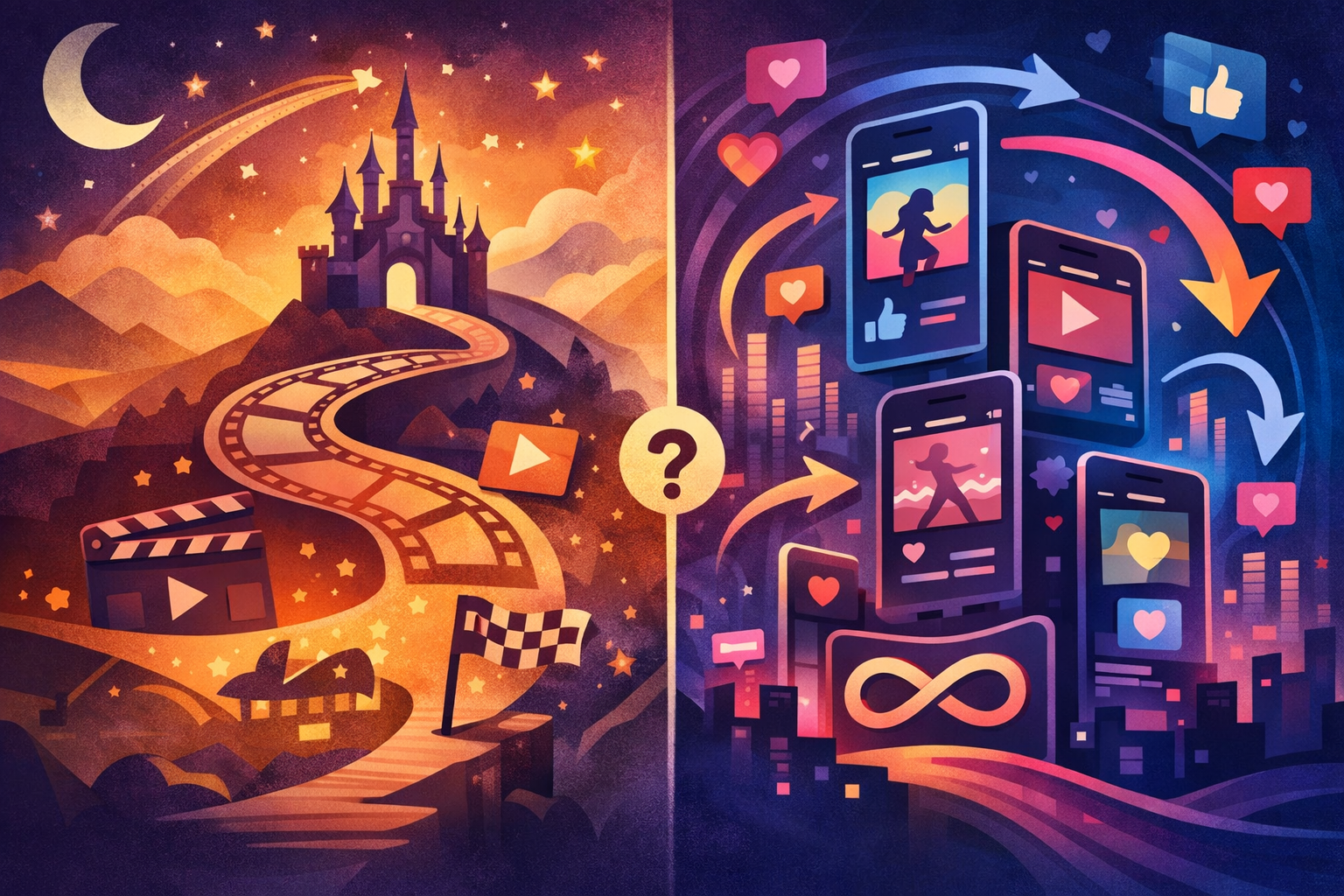
Disney’s short form strategy is becoming one of the most closely watched shifts in entertainment right now, especially as TikTok continues to define how modern audiences consume video on a daily basis. While Disney has announced new vertical video initiatives and major investments in generative technology, the deeper question is not whether Disney can produce short videos. The real question is whether short form alone is enough to recreate the daily habit loop that TikTok has spent years building.
This distinction matters because TikTok did not win attention by simply making videos shorter. It won by reshaping how often people return, how much effort watching requires, and how content fits into everyday moments rather than scheduled viewing time.
What Disney’s Short Form Strategy Actually Includes
Disney’s short form strategy is not theoretical. It has already moved into execution across multiple fronts, signaling that the company sees short video as more than promotional filler.
In early 2026, Disney confirmed plans to introduce a vertical video feed inside Disney+, designed to surface clips, highlights, and short-form storytelling moments alongside its traditional catalog. The goal is to increase engagement between longer viewing sessions, especially on mobile devices where younger audiences already spend most of their time.
At the same time, Disney announced a landmark agreement with OpenAI that allows licensed Disney characters to appear in user-generated AI video content created with Sora. According to Disney’s official announcement, the partnership with OpenAI is centered on the responsible use of AI, with an emphasis on protecting user safety and the rights of creators while expanding how fans engage with Disney stories. This move positions Disney to explore fan-driven short video without abandoning control over its intellectual property.
Together, these initiatives show that Disney understands short form as a strategic layer, not just a marketing experiment.
Why TikTok’s Habit Loop Is Still Different
TikTok’s advantage has never been video length alone. TikTok built a habit loop that encourages repeated daily use without asking for commitment, completion, or narrative investment.
A TikTok session does not require finishing anything. Viewers can stop at any time without feeling unfinished. The feed continues endlessly, and the cost of leaving is low. This structure makes TikTok compatible with fragmented attention and frequent check-ins throughout the day.
Disney, by contrast, has historically trained audiences to sit down and watch. Even its most successful franchises rely on anticipation, payoff, and narrative closure. Short form inside Disney+ still exists within an ecosystem designed around episodes, movies, and seasons.
This difference explains why simply adding vertical video does not automatically create TikTok-like behavior.
Disney’s Short Form Strategy Faces a Habit Design Challenge
Disney’s short form strategy introduces new content formats, but habit formation depends on more than format. It depends on how content fits into daily routines.
TikTok thrives on low-stakes consumption. Viewers do not feel pressure to pay attention, remember details, or stay until the end. Disney content, even when short, often asks for emotional investment and narrative focus.
That does not make Disney’s approach weaker. It makes it different.
If Disney treats short form as supplemental content that fills gaps between larger releases, it may increase engagement without fundamentally changing behavior. If Disney instead redesigns how short content is surfaced, refreshed, and personalized, it could gradually train a more frequent return cycle.
The OpenAI and Sora Partnership Signals a Broader Shift
The OpenAI agreement is one of the most important signals within Disney’s short form strategy because it acknowledges a reality TikTok has embraced from the beginning. Fans do not just want to watch. They want to participate.
By allowing licensed characters to appear in user-generated AI videos, Disney is testing a controlled version of participatory culture. This differs from TikTok’s open remix ecosystem, where trends evolve unpredictably and creators reinterpret content freely.
Disney’s approach prioritizes safety, consistency, and brand protection. TikTok prioritizes velocity, iteration, and cultural experimentation. Both models can succeed, but they optimize for different outcomes.
What remains unclear is whether Disney will allow these AI-generated short videos to influence discovery in the same way TikTok allows creator content to reshape trends organically.
Short Form Does Not Automatically Equal Daily Return
One of the most common misconceptions in media strategy is that short videos inherently drive daily usage. TikTok disproved this by showing that repetition, personalization, and frictionless discovery matter more than duration.
Disney’s short form strategy could succeed if it encourages habitual exploration rather than episodic sampling. That means emphasizing freshness, variation, and discovery rather than highlights alone.
Without that shift, short videos risk becoming bonus content. Bonus content rarely builds daily habits.
What This Means for Creators and Fans
For creators, Disney’s expansion into short form opens new opportunities, especially for those interested in storytelling, fandom, and brand-aligned creativity. However, the incentives will likely differ from TikTok’s creator economy.
TikTok rewards experimentation and iteration. Disney is more likely to reward polish, alignment, and narrative cohesion.
For fans, the evolution could bring new ways to engage with beloved franchises between major releases. Whether that engagement becomes habitual depends on how much freedom and discovery Disney ultimately allows.
Disney’s Short Form Strategy Outcome Is Still Open
Disney’s short form strategy is not an attempt to replace TikTok. It is an attempt to adapt to a world where attention is fragmented and discovery happens continuously.
TikTok built a habit loop that thrives on low commitment and constant novelty. Disney brings unmatched intellectual property, storytelling expertise, and global reach. If Disney successfully blends short form with participation and discovery, it could create a new model rather than copying TikTok’s.
The question is not whether Disney can make short videos. It is whether Disney can redesign how audiences return when they are not sitting down to watch.
You Might Also Like
- The End of the Troll: Understanding Rage-Bait Regulation on TikTok
- The Future of Digital Presence: A Deep Dive into AI Likeness Licensing
- The Labubu Economy Pop Mart Trend: The Definitive 2026 Market Analysis
- The 365 Buttons TikTok Trend: A Movement Against Overthinking
- The Jon Hamm Dissociation Dance: A Cultural Icon of 2026