Turning My Mom Into Me: TikTok’s Y2K Mom Makeover Trend
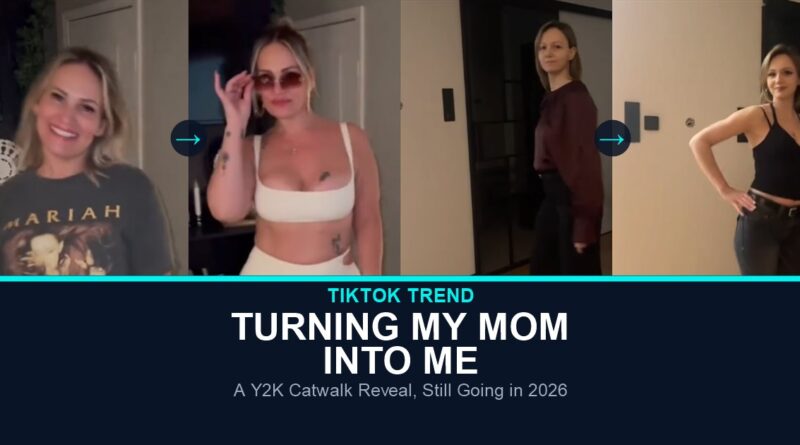
Turning my mom into me is the TikTok trend where kids raid their own closets, dress their mothers in Y2K crop tops and low-rise jeans, and film the big reveal like a runway entrance. It is not new. The format first went properly viral in December 2022, and nearly four years later, people are still making it.
That is the real story here. This is not breaking news about a trend that started last week. It is a format that outlasted its own viral moment, kept getting remade long after the press cycle moved on, and is still showing up on For You pages in 2026 with completely different soundtracks than the one that made it famous.
What to know:
- Turning my mom into me involves filming a mom in her own everyday style, then cutting to her re-entering in her kid’s clothes, styled and strutting like a model.
- The format first went viral in December 2022, covered by NBC News, E! Online, and Bored Panda, soundtracked to a sped-up remix of Skee-Lo’s 1995 song “I Wish.”
- It never fully stopped. Real TikTok videos using the same format are still being posted in 2025 and 2026, now set to a mix of different sounds rather than one shared track.
- Y2K staples (crop tops, low-rise jeans, butterfly hair clips) are the usual wardrobe, tying this directly into TikTok’s broader, already-documented 2026 nostalgia wave.
- The moms who took part in the original 2022 coverage described it as a genuine confidence boost, in their own words, not just a joke at their expense.
In this article
What Turning My Mom Into Me Actually Looks Like
Every version of turning my mom into me follows roughly the same three beats. First, the mom appears on camera in her own regular clothes, whatever she’d normally wear around the house or out running errands. Then she steps out of frame for an outfit change. She comes back in her kid’s clothes instead, usually Y2K-leaning pieces: a cropped tank or baby tee, low-rise jeans, platform shoes, sometimes a butterfly hair clip.
The reveal is the whole point. Moms walk back in like they’re on a runway, pose, mug for the camera, and the clip usually ends there. There’s no voiceover explaining the joke and no real competition structure. It’s a transformation video built entirely around one cut and one entrance.
The original version of the trend leaned on one specific song: a sped-up remix of Skee-Lo’s 1995 track “I Wish,” credited on TikTok under the sound name “evie.” That sound is what carried the format through its original viral run. It is notably absent from the newer examples below, which is its own small piece of evidence about how this trend actually aged, covered further down.
Where It Started: December 2022’s Viral Moment
Turning my mom into me did not begin as a mother-daughter format at all. According to Bored Panda’s own reporting, an early version of the clothes-swap idea is credited to a creator it identifies as “@jasminfogeddd,” in a video that dressed up a father in his son’s clothes rather than a mom. A creator Bored Panda identifies as “@malindahlgren0” is credited with adapting that same swap-and-reveal structure into the mom-and-daughter version that actually took off.
Once the mom version caught on, it spread fast. By late December 2022, NBC News reported the trend’s hashtag had already passed 230 million views, and both E! Online and Bored Panda ran their own coverage within days of each other, each pulling from a wave of videos that had been piling up across the app that month.
One of the biggest individual videos came from creator Hannah Hinckley, whose clip of her mother Heather Brown’s transformation reportedly drew around 30 million views on its own, per E! Online’s reporting. Influencer Alix Earle also posted her own version that December, captioning it to make a point beyond the joke: “This is actually how she dresses to go out too.”
Other participants put real numbers behind the moment too, per NBC News’s reporting. A video from creator Bella Ramirez, 20, turning her 48-year-old mother Edsyl Ramirez into a crop top, low-rise jeans, and a black jacket drew more than 1.6 million views on its own. Camryn Morris’s version, which restyled her mom in high-waisted jeans and a white cropped corset, passed 721,000 views; Morris also told NBC News she’d personally adopted her mom’s 1990s-2000s aesthetic as her own everyday style since.
NBC News’s coverage also noted the format didn’t stay limited to mothers and daughters for long. Versions involving dads, grandparents, and siblings turning each other into one another showed up the same month, using the same swap-and-reveal structure with a different pair of family members in front of the camera.
Hannah Hinckley, whose own video with her mother became one of the trend’s most-viewed clips, used her interview with NBC News to point at something bigger than the joke: an unspoken rule that women are expected to dress differently once they hit a certain age. That’s the actual argument sitting underneath turning my mom into me, the trend, dressed up as a lighthearted transformation video rather than a straightforward statement about age.
That December 2022 wave is genuinely what most of the internet still associates with this trend, including the specific sound, the specific wardrobe choices, and the specific framing (a lighthearted but real statement about age and what women are “supposed” to wear). What’s less well covered anywhere is what happened to the format after that initial news cycle ended.
Real Examples Still Going in 2026
The short answer: turning my mom into me didn’t disappear, it just stopped making headlines. Real videos using the exact same swap-and-reveal structure are still being posted years after the original news cycle, including well into 2026.
One clear example comes from creator @kwinbee06, posted in 2025. The video’s own caption doubles as direct evidence that creators are aware this is an older format and are deliberately reviving it rather than stumbling into something brand new: “I hope it’s not too late to Jump on this trend 🤭 Dressing Up My Mom Like Me ❤️”
@kwinbee06 I hope it’s not too late to Jump on this trend 🤭 Dressing Up My Mom Like Me ❤️ #dressup #mom #transformation
♬ GANO – Slowed – VUKEINE & Mc Maroladão
A second confirmed example, posted in July 2026, comes from creator @fjwcwhvon3, captioned plainly: “Turning My Mom Into Me #fyp #trend #viral #edit #dressingmymomlikeme.” The hashtag choice alone, #dressingmymomlikeme, shows the format has picked up its own slightly different naming over time even as the structure stays identical.
@fjwcwhvon3 Turning My Mom Into Me #fyp #trend #viral #edit #dressingmymomlikeme
♬ original sound – fjwcwhvon3
A third, from creator @sevenskyedits, posted in June 2026 and captioned “Turning my mom into me trend #viral #mom #transformation,” confirms the same pattern again: real people, still making this exact video, years after it stopped being news.
None of these three videos use the original “evie” sound from 2022. Each one runs on something different, from an original audio track to an unrelated slowed song. That’s a real, checkable detail, not a guess, and it says something specific about how this trend aged: it survived by becoming a reusable format rather than staying tied to one sound, the same way a dance challenge can outlive its original song once the moves themselves become the recognizable part.
Why a Nearly Four-Year-Old Trend Keeps Coming Back
A format this simple is easy to repeat, which is a big part of the answer. Turning my mom into me doesn’t need choreography, a specific song, or any editing skill beyond one cut. Anyone with a mom willing to participate and a closet full of Y2K-style clothes can make a version of it in one take, which keeps the barrier to entry close to zero even years after the original wave.
The wardrobe itself is the other half of it. Crop tops, low-rise jeans, and butterfly clips are specifically Y2K and early-2000s pieces, and this site has already tracked a broader 2026 TikTok nostalgia wave built around exactly that kind of throwback material resurfacing again and again.
Turning my mom into me fits that same pattern. It isn’t a new nostalgia trend invented in 2026, it’s an older format that happens to be built out of the same nostalgic wardrobe TikTok keeps circling back to anyway, which gives it a reason to keep resurfacing instead of fading out for good.
There’s also a simple content-creation logic to it. A transformation video with a clear “before” and “after” is a dependable, low-effort format for getting watch-through, the same reason makeup transformation and outfit-change videos remain a reliable category on the app regardless of whatever specific trend is peaking that month.
Turning my mom into me gives that same structure a built-in emotional hook, a parent and child doing something together on camera, that a solo transformation video doesn’t have. It’s a reusable premise, which is exactly why turning my mom into me keeps getting remade instead of retired.
What the Moms Have Actually Said
The mothers who took part in the original 2022 wave are real people, not characters in someone else’s joke, and what they said on the record is worth repeating directly rather than guessing at how they might have felt.
Heather Brown, whose transformation video with daughter Hannah Hinckley became one of the trend’s biggest individual clips, told NBC News at the time: “I would say this has been a good reminder to me that, you know, fashion is a reflection of your personality. It was empowering to be able to wear something that I felt really confident in.”
Camryn Morris, another participant from that same original wave, described watching her mom’s reveal in similar terms, per E! Online’s reporting: “That made me feel excited because I feel like it kind of boosted [her] confidence in a way.”
Both quotes point to the same thing: the moms who actually spoke about the experience described it as a real confidence boost, not a bit they were going along with reluctantly. That’s the part of the 2022 coverage worth carrying forward, more than the specific views count or the specific sound, since it’s the detail that explains why a format this simple kept getting remade long after its original moment passed.
NBC News framed the broader reaction in similar terms, reporting that commenters and participants repeatedly described the moms as looking “happier” and “glowing” once they’d changed, and connected the trend to a pushback against ageism on TikTok specifically.
Turning my mom into me works as a joke format on the surface, but the actual commentary attached to it, from the people who made the original videos, was consistently about something more specific: who gets told they’re too old to dress a certain way, and why that rule doesn’t hold up once you actually test it on camera.
Frequently Asked Questions
Is “turning my mom into me” a new TikTok trend?
No. The format first went viral in December 2022. It’s still being actively remade in 2025 and 2026, which is the genuinely interesting part, but the trend itself is nearly four years old.
What song is used in the trend?
The original 2022 wave used a sped-up remix of Skee-Lo’s 1995 song “I Wish,” credited on TikTok as the sound “evie.” Newer examples from 2025 and 2026 use a range of different sounds instead, including original audio tracks.
What clothes are typically used?
Y2K and early-2000s pieces: crop tops, low-rise jeans, platform shoes, and butterfly hair clips are the most common choices, pulled straight from the kid’s own closet.
Did the trend start with moms?
Not according to Bored Panda’s reporting, which traces an earlier clothes-swap version to a father-and-son video before the mom-and-daughter format took over and became the version everyone remembers.
How do people make their own version?
The format only needs two shots: the mom in her own everyday outfit, then a cut to her re-entering in her kid’s clothes. No specific song is required anymore, based on the real 2025-2026 examples covered above, just the same before-and-after structure the trend has always used.
Sources: NBC News, E! Online, Bored Panda, and the TikTok creators linked throughout.