TikTok Economic Impact Report: $81 Billion in 2025 US GDP
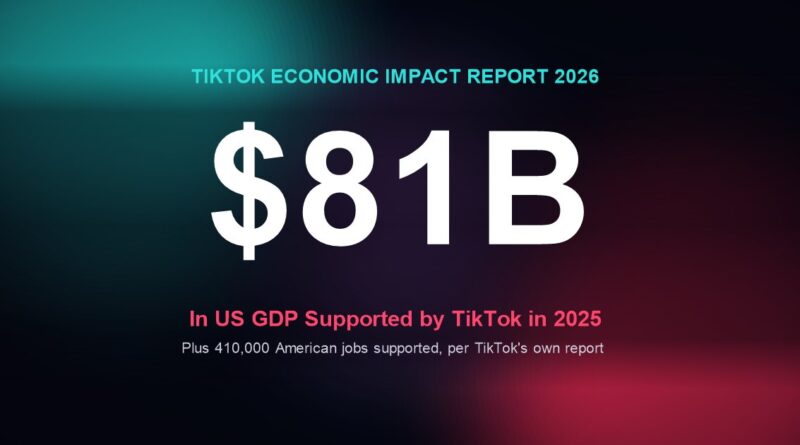
TikTok’s own newsroom put a number on what the platform says it’s worth to the US economy. A TikTok economic impact report released October 1, 2026 claims the platform supported $81 billion in US GDP and 410,000 American jobs in 2025, along with a long list of figures on small businesses, local spending, and informal learning. The findings come from PF Global, a research firm TikTok commissioned to produce the study, not from a government agency or an independent academic body.
That distinction matters for how to read everything that follows. This TikTok economic impact report is a real, dated announcement with real, specific figures, and those figures are worth covering in detail. It’s also a report TikTok paid for and TikTok published, through its own Newsroom, about itself, at a moment when the platform remains under active legal and regulatory scrutiny in the US. Both things are true at once, and this piece treats them that way throughout, rather than presenting PF Global’s numbers as independently verified fact.
What to know:
- The headline claim: $81 billion in US GDP and 410,000 American jobs supported by TikTok-related economic activity in 2025, according to the TikTok economic impact report TikTok commissioned from PF Global.
- Who did the research: PF Global, surveying more than 11,000 US adults and 5,000 businesses and combining those results with government statistics and TikTok’s own platform data.
- The small-business figures: 27 million Americans say they visited an independent shop, cafe, or restaurant for the first time after discovering it on TikTok, generating roughly $4.7 billion in local spending.
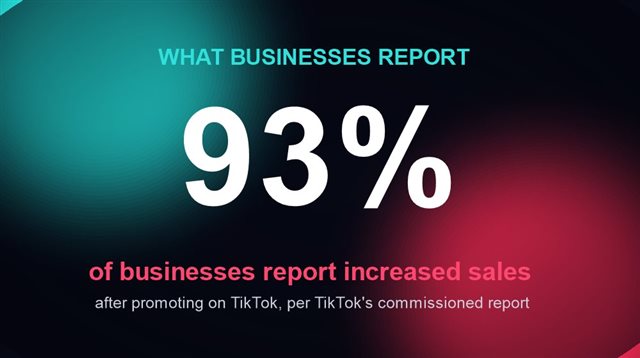
- The business sentiment numbers: 93% of businesses report increased sales after promoting on TikTok, and 76% call the platform critical to their survival.
- The big caveat: this is a TikTok-commissioned report about TikTok’s own impact, not an independent or government audit, and it follows a pattern of fast-growing figures across TikTok’s last few self-published economic reports.
In this article
TikTok Economic Impact Report: The Headline Numbers
TikTok USDS Joint Venture LLC, the entity that has run TikTok’s US app, user data, and recommendation algorithm since January 2026, published this TikTok economic impact report on its own Newsroom under the headline “TikTok Supported $81 Billion in US GDP and 410,000 American Jobs.” The company says the figures reflect economic activity tied to TikTok throughout all of 2025, measured by PF Global through a combination of surveys and government economic data.
Adam Presser, CEO of TikTok USDS Joint Venture, is quoted directly in the release: “More than 200 million Americans turn to TikTok to discover something new.” That line, more than the dollar figures around it, is the actual thesis of this TikTok economic impact report: TikTok wants to be understood as a discovery engine with downstream economic effects, not just an entertainment app people scroll for fun.
The $81 billion GDP figure and the 410,000 jobs figure are both described in the report as activity “supported by” TikTok, a specific phrase worth reading carefully. It doesn’t mean 410,000 people are TikTok employees, and it doesn’t mean $81 billion in revenue flowed directly through the app. It means PF Global’s modeling, the backbone of this TikTok economic impact report, attributes that much economic activity, across businesses, creators, and consumer spending, to TikTok’s role in the chain somewhere, a methodology choice this piece returns to later in more detail.
How the Report Says TikTok Is Changing Local Business
The most specific, checkable-feeling numbers in this TikTok economic impact report are the ones about local, in-person businesses. The report says 27 million Americans visited an independent shop, cafe, or restaurant for the first time after discovering it on TikTok, generating an estimated $4.7 billion in local spending. A separate 47 million American adults say they found a local business through TikTok videos at some point, and 50 million say they went back to a business they’d originally discovered on the app.
Beyond individual shops and restaurants, the report attributes $14 billion in additional US spending to tourism, retail, and hospitality combined, and says TikTok content drove 19 million additional visits to US towns, cities, and tourist attractions. That’s the “TikTok made me go there” effect, applied at a national, dollar-figure scale rather than as a single viral anecdote about one small town’s coffee shop, and it’s one of the TikTok economic impact report’s most repeated talking points.
This lines up with a pattern this site has already covered on the commerce side specifically. A Momentum Works and Tabcut report covered here in August found that TikTok Shop’s Shop tab overtook Video and Live as the platform’s largest attributed US sales channel for the first time in 2026, at 51.4% of GMV.
That report, unlike this one, came from an independent market-research firm with no TikTok funding behind it. It measured actual transaction data rather than self-reported survey responses, a real methodological difference worth keeping in mind heading into the PF Global survey findings below.
What Businesses Themselves Are Saying
A large share of this TikTok economic impact report is built from survey responses, businesses describing their own experience with the platform in their own words, filtered through PF Global’s questionnaire. Taken at face value, the picture is strongly positive: 93% of surveyed businesses report increased sales after promoting on TikTok, 84% say the platform reaches customers they couldn’t otherwise reach, 83% call it important for attracting customers, 80% say it helped them scale operations, and 76% say TikTok is critical to their business’s survival.
The entrepreneurship numbers in the TikTok economic impact report follow the same shape. The report says 1.8 million American entrepreneurs sold products or services through TikTok in 2025, and 96% of businesses using TikTok Shop specifically report selling out of products at some point that year. Among businesses majority-owned by people under 30, a subgroup PF Global broke out separately, 86% call the platform critical to their business’s existence, a few points higher than the 76% figure for businesses overall.
Numbers this consistently favorable, all drawn from one company’s commissioned survey of businesses that chose to use that company’s own platform, are a real case of selection working in one direction. A business still actively promoting on TikTok in 2026, willing to respond to a TikTok-linked survey about TikTok, is not a random cross-section of every US business that has ever tried the app, including the ones that quietly stopped.
None of that means the TikTok economic impact report’s figures are false. It means they describe TikTok’s current, engaged user base of businesses, not a neutral sample of American commerce broadly, a distinction the report itself doesn’t spell out but that’s worth keeping in view while reading its percentages.
TikTok as a Classroom: Learning and Entrepreneurship
A section of the report moves away from commerce entirely and into education and career development. PF Global’s figures here credit TikTok with supporting 3.6 billion hours of what the report calls “informal learning” in 2025, a number the report itself translates into roughly 670,000 bachelor’s degree programs’ worth of instructional time, a comparison lifted directly from the report rather than a framing added by this article.
Separately, this part of the TikTok economic impact report says 45 million American adults credit TikTok with helping them understand their career options, and 60% of people who post regularly on the platform say they’re interested in starting their own business. Put together with the entrepreneurship figures above, 1.8 million people already selling through the app, this section is framing TikTok as a kind of on-ramp: first informal education content, then interest in starting something, then an actual storefront.
That “670,000 bachelor’s degrees” comparison is a good example of a number that’s technically sourced to the report but worth reading skeptically on its own terms. Hours of casual video-watching and a four-year, accredited degree program aren’t actually the same unit of value, and the report doesn’t explain the conversion math behind that specific comparison. It’s included here because it’s a real, directly sourced figure from the TikTok economic impact report, not because this site is vouching for the comparison as a meaningful equivalence.
A Report TikTok Paid For: What That Means for the Numbers
This is not the first time TikTok has published a TikTok economic impact report like this one, and the pattern across editions is worth laying out plainly. In April 2024, TikTok commissioned Oxford Economics to produce a US economic impact study that put TikTok’s GDP contribution at $24.2 billion for 2023, supporting roughly 224,000 jobs, based on a survey of about 1,050 businesses and 7,500 consumers.
Less than a year later, in early 2025, a separate TikTok-commissioned Oxford Economics report put a different figure, 28 million US jobs, on businesses that simply “have TikTok business accounts,” a far broader and looser standard than jobs actually dependent on the platform.
That 2025 figure drew direct, pointed skepticism from outside coverage. Social Media Today’s analysis of the 28-million-jobs claim noted plainly that “those 28 million are not reliant on TikTok, as such, but they do, at least in theory, glean some benefit from the app,” and went further, calling TikTok’s broader framing around the figure “somewhat skewed logic from TikTok, and a misdirection from the real concerns that have prompted US officials to enforce a sell-off of the app.”
That’s an outside outlet’s direct assessment, not this site’s own. It’s included here because it’s the clearest independent pushback found against TikTok’s pattern of self-commissioned economic claims.
Now, in October 2026, the headline GDP figure has more than tripled from that 2024 baseline, $24.2 billion to $81 billion, and the jobs figure has grown from 224,000 to 410,000, while the research firm behind the number has changed again, from Oxford Economics to PF Global. A bigger, more current survey (11,000 adults and 5,000 businesses, versus 2024’s roughly 8,550 combined respondents) partly explains a larger number.
It doesn’t fully explain a more than threefold jump in GDP contribution in two years, and the report itself doesn’t walk through that comparison for readers. Same-day independent coverage from Forbes and eMarketer both reported the 2026 figures straightforwardly, as TikTok’s own claim, without independently re-verifying the underlying GDP modeling themselves.
None of this means the $81 billion figure is wrong. It means it’s TikTok’s own number, produced by a firm TikTok paid, published on TikTok’s own Newsroom, following two prior editions that grew sharply year over year and that at least one outside outlet has directly criticized for loose framing. The figures in this TikTok economic impact report are reported here as exactly that: TikTok’s claim, sourced to TikTok, not as independently confirmed economic fact.
Why This Report Is Landing Right Now
This TikTok economic impact report’s timing isn’t incidental. TikTok USDS Joint Venture LLC only took over operational control of the US app, user data, and recommendation algorithm in January 2026, following the ownership restructuring forced by the 2024 divest-or-ban law. A report like this one gives the new US entity a positive, numbers-heavy story to tell just as that entity settles into running the platform day to day.
It also arrives while TikTok is still working through real legal exposure elsewhere. This site covered Alabama’s first-in-the-nation state settlement with TikTok just days earlier, in late September, over algorithm and youth-mental-health claims, part of a broader wave of state and federal legal pressure that’s been building for more than a year.
A TikTok economic impact report emphasizing jobs, small-business growth, and economic contribution is, functionally, a counter-narrative to that pressure, even though the report itself never directly references the legal fights. Both things, the legal exposure and the economic-impact messaging, are real and are happening at the same time; readers can draw their own conclusion about how connected they are.
What happens next with this specific TikTok economic impact report is mostly about whether anyone outside TikTok tries to independently check the modeling behind the $81 billion figure, the way outside researchers and journalists have occasionally scrutinized similar self-commissioned reports from other large tech platforms. As of this report’s release, no independent economist or academic group has published a competing estimate of TikTok’s actual US economic footprint.
Quick answers
What does TikTok’s 2026 economic impact report actually claim? That TikTok-related economic activity supported $81 billion in US GDP and 410,000 American jobs in 2025, based on research TikTok commissioned from PF Global.
Who produced this TikTok economic impact report? PF Global, a research firm TikTok paid to conduct this specific TikTok economic impact report. It surveyed more than 11,000 US adults and 5,000 businesses and combined those results with government economic data and TikTok’s own platform data.
Is this an independent or government report? No. It’s a TikTok-commissioned study, published through TikTok’s own Newsroom. It hasn’t been independently audited, and no competing economist or academic estimate of TikTok’s US economic impact has been published as of this report’s release.
How does this compare to TikTok’s past economic impact reports? TikTok’s 2024 Oxford Economics report put its US GDP contribution at $24.2 billion for 2023 and 224,000 jobs. A separate early-2025 Oxford Economics report’s 28-million-jobs figure drew direct outside criticism for loose methodology. The 2026 PF Global report’s $81 billion and 410,000-jobs figures are both sharply higher, using a new research firm and a larger survey.
What’s the single most-cited business statistic in the TikTok economic impact report? That 93% of surveyed businesses report increased sales after promoting on TikTok, with 76% calling the platform critical to their business’s survival.
Sourced from TikTok’s Newsroom announcement, published October 1, 2026. Additional reporting via Forbes and eMarketer. Prior-report comparison via Yahoo Finance’s coverage of the 2024 Oxford Economics report and Social Media Today’s analysis of the early-2025 edition. TikTok Shop GMV figures via this site’s own August 2026 coverage of the Momentum Works/Tabcut report. Every figure in this TikTok economic impact report traces back to one of the sources linked above.