Alabama TikTok Settlement: $100M Deal Sets New Teen Rules
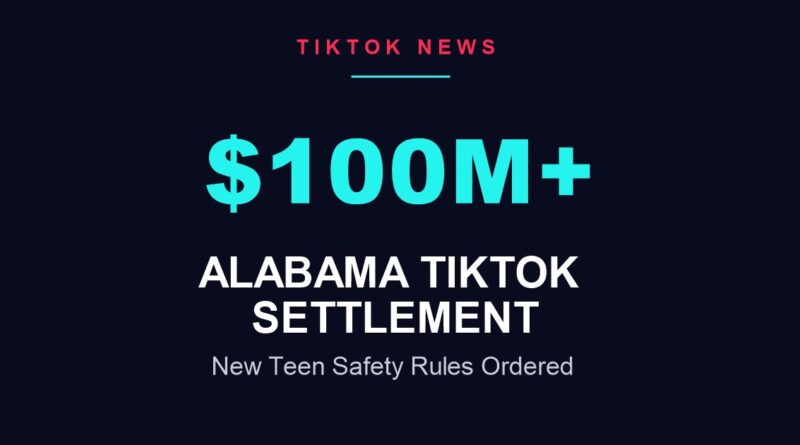
The Alabama TikTok settlement will send the state at least $100 million, and as much as $300 million, according to an announcement from Attorney General Steve Marshall’s office. TikTok reached the deal on September 26, 2026, just three days before it was set to become the first state in the country to take the company’s youth-safety claims in front of a jury.
The agreement resolves a lawsuit Alabama filed in 2025 accusing TikTok of designing its platform with addictive features, knowingly exposing young users to serious mental health harms, and misleading the public about how safe the platform actually is. In exchange for closing the case, TikTok agreed to a long list of new safety requirements for teen accounts in Alabama, on top of the payment.
What to know:
- The Alabama TikTok settlement guarantees the state a minimum $100 million payment, due within 45 days, with a ceiling of $300 million total.
- Up to $183.8 million of that ceiling depends on whether other states reach their own qualifying settlements with TikTok within a specified window.
- The deal was announced September 26, 2026, three days before jury selection had been scheduled to start in what would have been the first state trial of TikTok’s algorithm and addiction claims.
- TikTok must roll out a two-hour daily time limit, midnight-to-6 a.m. access restrictions, default-private teen accounts, a non-personalized feed option, and a ban on cosmetic-procedure filters for teen users in Alabama, among other changes.
- This is a separate legal track from TikTok’s $400 million federal COPPA settlement and the still-unresolved Musical.ly consent decree fight, since Alabama sued the company directly in 2025 over algorithm and addiction claims, a different case with different plaintiffs.
In this article
The Alabama TikTok Settlement Terms
The financial core of the Alabama TikTok settlement is straightforward on its face and more conditional underneath. Alabama is guaranteed at least $100 million, payable within 45 days of the announcement, according to the Alabama Attorney General’s own press release.
The Guaranteed Payment
That $100 million is not contingent on anything else happening. It’s the floor of the Alabama TikTok settlement, due to the state regardless of what any other state does with its own case against the company.
The Ceiling, and Why It’s Not Guaranteed
The total could reach $300 million, but the extra $200 million above the guaranteed floor isn’t unconditional. Up to $183.8 million of that additional amount is tied to whether other states reach their own qualifying settlements with TikTok within a set timeframe, according to CBS News’s reporting on the deal. In plain terms, Alabama’s own payout is partly linked to how the rest of the country’s legal fight with TikTok plays out, not solely to what Alabama itself proved in its case.
Attorney General Marshall framed the deal as a direct win for families, not just a budget line for the state. “This is a great day for Alabama parents. Tonight, they can rest easier knowing real protections are in place to shield their children from the dangers of social media addiction. TikTok has agreed to give parents real control over what their kids see and how much time they spend on the app. We’ve said from day one that our number one goal was to stand up for Alabamians when they are being harmed, and today, we did exactly that,” Marshall said in the Attorney General’s office’s press release.
Timeline: How Alabama’s Case Against TikTok Got Here
The Alabama TikTok settlement is the ending point of a case that had been heading toward a real courtroom for months, not a quiet backroom deal that appeared out of nowhere.
- 2025: Alabama sued TikTok, alleging the platform’s algorithm and design features were built to be addictive, that the company knowingly exposed young users to serious mental health harms, and that TikTok misled the public about the platform’s actual safety.
- August 26, 2026: Meta reached its own settlement with a coalition of 52 attorneys general, including Alabama’s, over nearly identical youth-safety claims against Facebook and Instagram, a case discussed in more detail below.
- Week of September 21, 2026: Both sides prepared for a jury trial that would have made Alabama the first state in the country to put TikTok’s algorithm and addiction claims directly in front of a jury.
- September 26, 2026: TikTok and Alabama announced the settlement, three days before jury selection had been scheduled to begin the following Monday, September 29.
That last data point is the one worth sitting with. Alabama wasn’t threatening a trial as leverage, it was days away from actually empaneling a jury. Settling this close to jury selection is usually a sign both sides had real reasons to want to avoid what a trial would have exposed, whether that’s discovery material becoming public, an unpredictable jury outcome, or both.
What Alabama Teens Will See Change on TikTok
The Alabama TikTok settlement isn’t just a check the company writes and walks away from. It requires specific, described changes to how the app behaves for teen accounts in the state. According to the Attorney General’s office and confirmed independently through CBS News’s and WBHM’s reporting, TikTok agreed to:
- A two-hour daily usage time limit for teen accounts, with parental controls available to set an even tighter limit.
- “Productive pause” prompts that interrupt continuous use at 15 minutes, then again at 60 and 90 minutes.
- A nighttime usage restriction blocking access from midnight to 6 a.m., plus added restrictions on messaging and push notifications overnight and during school hours.
- An option for teens to switch to a non-personalized default content feed, effectively an opt-out of the algorithmic “For You” page for minors.
- A ban on cosmetic-procedure filters for teen accounts.
- Teen accounts set to private by default.
- Stronger, more robust age verification measures.
- Strengthened content moderation limiting adult-account interaction with teen accounts, including parental alerts about suspicious interactions.
Taken together, this list reads less like a single feature update and more like a full redesign of what a teen account can even do on the platform. The two-hour cap and the overnight blackout are the two most visible changes for an actual Alabama teenager using the app day to day; the default-private setting and the parental-alert system are the ones aimed more directly at limiting contact between adult accounts and minors.
None of these features are described as optional add-ons parents have to go find in a settings menu. Per the Attorney General’s office, they’re baked into how a teen account works by default in Alabama going forward, with parental controls layered on top for families who want to restrict things further.
TikTok’s Response
TikTok didn’t dispute the Alabama TikTok settlement’s terms in its public response, and it framed the changes as a continuation of existing work rather than a concession forced by litigation. A TikTok USDS Joint Venture spokesperson said the company’s priority has “always been fostering a safe and positive space where people can be creative, discover what they love, and connect with their community,” according to CBS News and WBHM’s independently matching reporting.
The same spokesperson added that the agreement “builds on our commitment and core objective to continually enhance our robust safety tools to protect teens.” That’s a notably different tone from a company contesting the underlying claims. TikTok’s public statement doesn’t concede the lawsuit’s specific allegations, but it also doesn’t push back against them, choosing instead to describe the new requirements as an extension of tools it says already existed.
How This Compares to Meta’s Alabama Settlement
The Alabama TikTok settlement didn’t happen in isolation. One month earlier, on August 26, 2026, Meta reached its own settlement with a coalition of 52 attorneys general, including Alabama’s, over nearly identical claims about Facebook and Instagram’s effect on young users, according to the Alabama Attorney General’s own release on that deal. That earlier Meta deal is the closest comparison point available for judging whether the Alabama TikTok settlement’s own terms are unusually tough or simply the going rate for this kind of case right now.
The overlap in the actual safety requirements is close to one-to-one. Meta’s settlement also included a two-hour daily time limit, “Productive Pause” interruptions at 15, 60, and 90 minutes, a midnight-to-6-a.m. overnight restriction, a ban on cosmetic-surgery and extreme-makeup filters for minors, and stronger age-assurance measures.
That resemblance isn’t a coincidence. Meta’s chief legal officer publicly called on the industry to follow its lead at the time of that announcement, saying, according to Alabama Reflector’s coverage: “we therefore call on our industry peers, TikTok and YouTube, to implement this new framework, right away.” Roughly a month later, TikTok’s own Alabama settlement landed with nearly the same feature list. Whether that reflects TikTok responding directly to Meta’s public challenge or simply facing the same underlying lawsuit and settling on comparable terms independently isn’t something either company’s public statements resolve. Both are plausible, and neither settlement’s own text draws that connection explicitly.
A Different Legal Track Than TikTok’s Federal Settlement
It’s easy to mix this up with TikTok’s other big 2026 settlement, but the Alabama TikTok settlement is a legally separate matter from the federal case this site has already covered twice this year.
In August, TikTok reached a $400 million settlement with the U.S. Department of Justice over alleged violations of COPPA, the federal children’s privacy law, a case about how TikTok collected and handled data from users under 13, not about the algorithm or addictive design. This site covered that deal in “TikTok’s $400 Million Settlement Is a Warning, Not a Fix”, including why a settlement with no admission of wrongdoing has limited deterrent value against a company TikTok Shop alone moved $50.3 billion through globally in the first half of 2026.
That federal settlement then hit its own complication, covered separately in “TikTok Consent Decree Ruling Puts $100M Payment in Doubt”: a federal judge tentatively questioned whether the government had adequately justified vacating a 2019 consent decree tied to Musical.ly, TikTok’s corporate predecessor, over under-13 data handling. That fight is specifically about whether $100 million of the federal settlement’s $400 million is contingent on that decree actually being lifted.
The Alabama TikTok settlement shares none of that legal machinery. It’s a state lawsuit, brought by Alabama’s own Attorney General under state law, over a different set of claims: the algorithm’s design and its effect on youth mental health, not under-13 data collection. The two cases happen to both concern TikTok and youth safety, and both happen to involve $100 million figures, but they’re different plaintiffs, different legal theories, and different courts. Nothing about the consent decree fight affects the Alabama settlement’s own $100 million floor, and nothing about the Alabama settlement resolves the still-open question over the federal decree.
What Happens Next
The most direct next step for the Alabama TikTok settlement is procedural: TikTok has 45 days from the September 26, 2026 announcement to pay Alabama the guaranteed $100 million. Building and shipping the actual product changes (the age-verification updates, the default feed change, the parental-alert system) is a separate rollout the Attorney General’s office hasn’t published a specific public deadline for.
The bigger open question is what happens in every other state. TikTok has faced similar youth-safety and algorithm-addiction lawsuits beyond Alabama’s, and this settlement’s own structure gives the company a direct financial reason to resolve more of them: up to $183.8 million of Alabama’s own potential $300 million is tied to other states reaching qualifying settlements of their own. Alabama becoming the first state to settle, rather than the first to actually try the case in front of a jury, sets a template other state attorneys general now have a real, published example to measure their own negotiations against.
Frequently Asked Questions
How much money will Alabama get from the TikTok settlement?
At least $100 million, due within 45 days of the September 26, 2026 announcement, according to the Alabama Attorney General’s office. The total could reach $300 million, with up to $183.8 million of that additional amount contingent on other states reaching their own qualifying settlements with TikTok.
Is this the same as TikTok’s $400 million federal settlement?
No. The Alabama TikTok settlement is a state lawsuit over algorithm design and youth mental health harm, filed by Alabama’s Attorney General in 2025. TikTok’s $400 million settlement was with the U.S. Department of Justice over federal COPPA violations tied to under-13 data collection, a separate case with a separate legal basis.
What changes are coming for teen TikTok accounts in Alabama?
A two-hour daily time limit, midnight-to-6 a.m. access restrictions, default-private accounts, an option to turn off the personalized “For You” feed, a ban on cosmetic-procedure filters, stronger age verification, and parental alerts about suspicious adult-to-teen contact, among other requirements.
Was Alabama really about to be the first state to take TikTok to trial?
Yes. Jury selection had been scheduled for Monday, September 29, 2026, three days after the settlement was announced. Had it gone forward, it would have been the first time a state’s algorithm-and-addiction claims against TikTok reached an actual jury trial.
Does the Alabama TikTok settlement change anything for users outside Alabama?
The specific safety requirements described in this settlement apply to teen accounts in Alabama. TikTok is facing similar lawsuits from other states, and the settlement’s own structure ties part of Alabama’s potential payout to whether other states reach comparable settlements, which gives the company a financial incentive to extend similar terms elsewhere.
Sources: Alabama Attorney General’s Office, CBS News, WBHM, TechCrunch, and Alabama Reflector.