
TikTok Community Guidelines 2026: What’s Changing and When
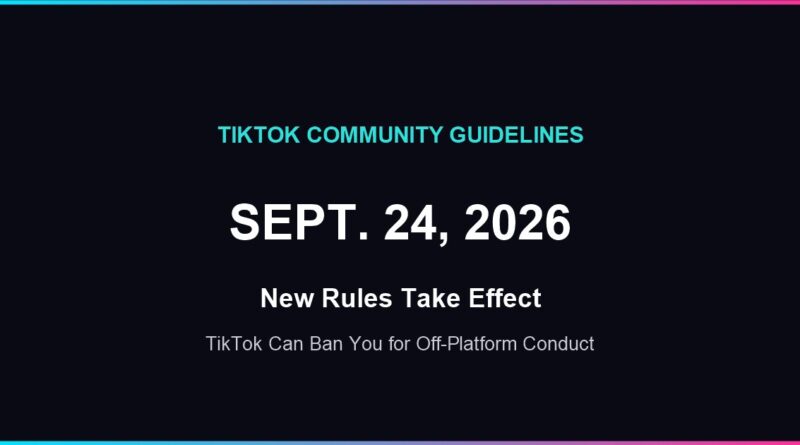
TikTok community guidelines change on September 24, 2026, and the most unusual part has nothing to do with what anyone posts on the app. Under the new version, TikTok can restrict or ban an account over things a person did entirely offline or on another platform, well before they ever opened TikTok, if the conduct is serious enough. That single provision is a real departure from how most platforms have historically defined their own jurisdiction, and it’s the piece of these TikTok community guidelines worth understanding before the deadline hits.
- The date: TikTok community guidelines take effect September 24, 2026, released a month earlier on August 25, per TikTok’s own version history
- The standout provision: TikTok can restrict or ban accounts over “egregious off-platform behaviors,” including membership in a violent or hateful organization, sexual abuse, severe violent crimes, or human trafficking
- Not actually brand-new: real account bans citing off-platform conduct were already happening in January 2026, months before this update, so the policy itself predates this specific refresh
- The rest of the guidelines cover the categories most platforms address: violence, hate speech, harassment, graphic content, scams, misinformation, and disclosure requirements for realistic AI-generated content
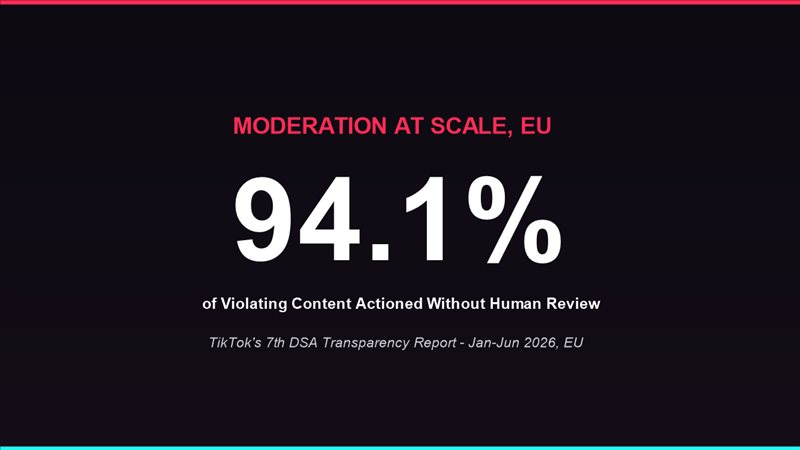
- The scale question: TikTok’s own EU transparency reporting shows 94.1% of violating content gets actioned without a human ever reviewing it, real context for whether case-by-case judgment calls like off-platform behavior can realistically happen at TikTok’s size
In this article
What’s Actually in TikTok Community Guidelines
TikTok community guidelines make up the platform’s full rulebook, and TikTok refreshes the document on a rolling basis, roughly once or twice a year. This version is dated August 25, 2026 on TikTok’s own site, with a plain notice at the top of the current guidelines telling readers exactly when it takes over: “On September 24, 2026, we are updating our Community Guidelines so you can continue to create, discover, and share safely on TikTok.”
The guidelines are organized into familiar categories for anyone who has read a major platform’s policy document before. Violence and hate speech are prohibited, along with support for groups TikTok classifies as violent or hateful. Harassment, bullying, and doxxing are covered under a safety and civility section. Scams, fraud, and deceptive commercial schemes have their own section, alongside TikTok Shop-specific rules. Misinformation is restricted specifically when TikTok determines it “could cause significant harm to individuals or society,” a standard that leaves TikTok real discretion over what counts.
AI-generated content gets its own real attention in the current guidelines: TikTok requires “clear labeling when AI or editing is used to realistically depict people or scenes,” and treats unlabeled realistic AI that misleads viewers about real people or public issues as an enforcement matter, not just a disclosure nicety.
None of that is unusual by industry standards. Every major platform’s guidelines cover roughly this same ground. What sets TikTok community guidelines apart from most competitors is a section that has nothing to do with what happens inside the app at all.
The Off-Platform Behavior Provision, Explained
Buried in the Accounts and Features section of TikTok community guidelines is a provision that most major platforms simply don’t have in this explicit a form. In TikTok’s own words: “We may also restrict or ban accounts belonging to people who have engaged in egregious off-platform behaviors, when we have sufficient evidence to support enforcement.”
TikTok names four specific categories of off-platform conduct that can trigger this:
- Being a member of a violent or hateful organization
- Committing an act of sexual abuse against a youth or adult
- Promoting or engaging in severe violent crimes, like murder
- Engaging in human trafficking
TikTok also lists four factors it says it weighs before acting on any of this: how much time has passed since the act occurred, whether penalties for it have already been served, whether the person has made real efforts toward rehabilitation, and what the potential impact on public interest discussion would be if the account were removed.
That last factor matters in practice. It’s the kind of language platforms typically use to carve out room for newsworthy figures, someone whose past conduct is itself the subject of legitimate public discussion, rather than treating every account tied to a disqualifying act identically.
It’s worth being precise about what’s actually new here, because it’s less than the framing “TikTok just added this rule” would suggest. This provision was not written from scratch for the September 2026 update. Real enforcement citing off-platform conduct was already happening in January 2026, months before this update takes effect, which means the underlying policy predates this specific refresh (see the enforcement section below).
What TikTok’s version history confirms is that the language survives, largely unchanged, into the guidelines taking effect September 24. The genuinely newsworthy part isn’t that TikTok invented this rule out of nowhere. It’s that a provision this unusual, one platform reaching past its own walls to judge a user’s life outside the app, is a live, current, and durable part of the rulebook, not a one-off experiment that quietly disappeared.
How Enforcement Actually Works
TikTok community guidelines describe a range of possible outcomes rather than a single fixed penalty. Depending on what happened, TikTok says the response “can mean a warning, temporary feature or account restriction, or a full account ban.” For people who try to evade enforcement by creating new accounts, TikTok’s language goes further: “we may ban all of their accounts, including associated accounts.”
That range matters for a category as broad as off-platform behavior. A member of a designated hateful organization and someone convicted decades ago of a violent crime, who has since served their sentence and built a public-facing rehabilitation story, are not the same case under TikTok’s own stated factors, even though both technically fall under the same provision. The four assessment factors exist specifically to sort cases like that apart, at least on paper.
Separately, TikTok community guidelines distinguish between content that gets removed outright and content that simply becomes ineligible for the For You feed, meaning it can still exist on a profile or show up in search, but TikTok’s recommendation system won’t actively push it to new viewers. That distinction runs through nearly every category in the guidelines, not just off-platform behavior, and it’s a mechanic this site has covered in more depth in its own explainer on how TikTok’s recommendation algorithm actually works.
TikTok’s Own Numbers on Moderation at This Scale
TikTok community guidelines are only as real as TikTok’s ability to actually enforce them. TikTok publishes its own answer to that question twice a year, in a transparency report required under the European Union’s Digital Services Act. The numbers below come from two different editions of that report, and they’re kept separate deliberately, since mixing figures from different reporting periods into one misleading trend line is a real, documented mistake this site has made before on a similar topic.
TikTok’s seventh DSA transparency report, covering January 1 through June 30, 2026 and published August 31, 2026, states that TikTok “reaches 189 million people across the European Union every month.” During that six-month window, TikTok says it “removed around 104 million pieces of content that violated our Policies,” and that “automated systems actioned 94.1% of violating content without human review.”
The prior edition, TikTok’s sixth DSA transparency report, covers July through December 2025 and was published February 27, 2026. It reports 178.3 million EU monthly active users for that earlier period and puts a specific human number behind the review side of the process: “3,674 human moderators with EU-language expertise,” broken down as 91 employed directly by TikTok and 3,583 working through contractors. That same report separately states 220,217,619 moderation actions taken by automation alone against 14,874,341 actions that involved a human reviewer, with an automation accuracy rate of 91.8%.
That 91.8% figure and the seventh report’s 94.1% figure are not the same measurement of the same thing, and this article isn’t treating them as a before-and-after. The sixth report describes an “accuracy” rate tied to precision and recall testing; the seventh report describes a share of violations “actioned” without human review. Neither report, in what TikTok itself published, restates a moderator headcount or claims a specific year-over-year change between editions, so none is calculated here.
What the two reports do establish clearly, each in its own words: TikTok is removing content at genuinely enormous volume, the overwhelming majority of it without a person ever looking at it. The human review layer that does exist, as of the most recent period TikTok has broken out a headcount for, numbers in the low thousands for the entire EU market.
That context matters directly for the off-platform behavior provision. Deciding whether someone’s off-platform conduct clears a “sufficient evidence” bar, and then weighing time elapsed, penalties served, rehabilitation, and public interest, is not the kind of judgment call an automated system built to catch bulk violations, spam, and clearly prohibited content is designed to make well. It’s a case-by-case human review question, running on a review layer that TikTok’s own numbers show handles a small fraction of total enforcement.
What Off-Platform Enforcement Has Actually Looked Like
The off-platform behavior provision isn’t a hypothetical clause sitting unused in a policy document. According to reporting from Piunikaweb, a wave of account-ban complaints began surfacing across Reddit, X, Instagram, and Threads starting in early January 2026, months before this September update takes effect. Piunikaweb reported that affected users received an identical notice: “Your account was banned because of serious misconduct outside the platform that goes against our Community Guidelines.”
Piunikaweb’s reporting described real, specific cases. One creator with roughly 20,000 followers said a second account was banned over an alleged connection to human trafficking or sexual abuse, while a separate main account with about 70,000 followers stayed active. Another user said their account was banned despite, in their own account, having posted only mindset and philosophy content since May 2024, and reported eventually getting the account restored after appealing directly to TikTok support.
Creator Ethan Levins said on X that TikTok banned his account and, according to Piunikaweb’s reporting, seized roughly $6,000 in creator earnings, gifts, and other purchases tied to the account.
A consistent thread runs through Piunikaweb’s reporting on these cases: the banned users said they were never given specifics about what off-platform conduct triggered the action, even in cases where an appeal eventually restored the account. That’s a real, practical tension in a policy built around individualized, evidence-based judgment calls. The guidelines describe a careful weighing process, but the people actually affected by it, per this reporting, experienced it as an unexplained, all-or-nothing notice.
What This Means for Creators and Everyday Users
For the overwhelming majority of people on TikTok, nothing in this TikTok community guidelines update changes daily use of the app. The categories it covers, violence, hate speech, harassment, scams, misinformation, and now-labeled AI content, are the same broad categories every major platform already polices, and ordinary posting, commenting, and scrolling isn’t affected by the off-platform provision at all.
The provision is narrow by TikTok’s own description, limited to a specific list of serious offenses rather than any negative off-platform behavior in general. But its existence is still worth knowing about for anyone building a following on the platform, since it means a TikTok account isn’t fully insulated from a creator’s life and record outside the app, in a way that isn’t true on every competing platform.
TikTok community guidelines also cover engagement manipulation and fake engagement directly, a related but separate enforcement area this site has covered in more depth in its own reporting on TikTok’s rage-bait and engagement-bait crackdown, worth reading alongside this piece for the fuller enforcement picture.
The practical takeaway from TikTok’s own transparency data is more about expectations than behavior change: enforcement at TikTok’s scale runs overwhelmingly through automated systems, and the harder, case-by-case calls, like weighing rehabilitation and public interest under the off-platform provision, depend on a comparatively small human review layer.
Anyone who believes they were wrongly actioned under any part of TikTok community guidelines, off-platform behavior included, has an appeals path through TikTok support, though the cases reported by Piunikaweb suggest that process hasn’t always come with a clear explanation of what triggered the original decision.
Quick answers
When do the new TikTok community guidelines take effect? September 24, 2026. TikTok’s own site lists the release date as August 25, 2026.
What is TikTok’s off-platform behavior policy? A provision letting TikTok restrict or ban accounts over serious conduct that happened away from the app, specifically membership in a violent or hateful organization, sexual abuse, severe violent crimes, or human trafficking, when TikTok says it has sufficient evidence.
Is the off-platform behavior rule new in this update? Not confirmed as new. Real account bans citing off-platform conduct were already being reported in January 2026, months before this September 2026 update takes effect, so the underlying policy predates this specific refresh of the guidelines document.
Does TikTok remove content automatically or do people review it? Mostly automatically. TikTok’s most recent EU transparency report (January-June 2026) states that automated systems actioned 94.1% of violating content without human review. TikTok’s prior report listed 3,674 human moderators with EU-language expertise for the July-December 2025 period.
Can a user appeal an account restriction or ban? TikTok’s enforcement process includes an appeals path through its support system. Users who spoke to Piunikaweb about off-platform-behavior bans in January 2026 said they didn’t always receive a clear explanation of what triggered the action, even when an appeal succeeded.
Primary sources: TikTok’s Community Guidelines, Accounts and Features section, and TikTok’s seventh and sixth EU Digital Services Act transparency reports. Reporting on real off-platform-behavior enforcement cases: Piunikaweb.