
Cat vs. Bear TikTok Video: Fearless New Hampshire Standoff (2026)
TikTok and PETA logos/trademarks referenced in this article’s hero image are property of their respective owners, used here for editorial identification purposes.
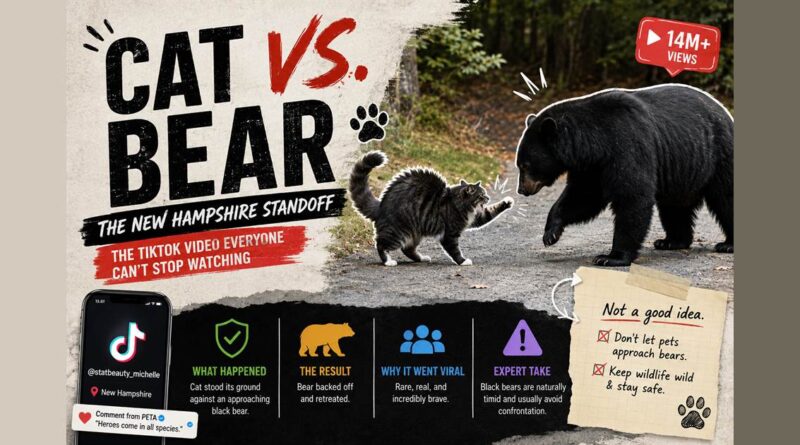
A cat vs bear TikTok video out of New Hampshire is going properly viral for a simple reason: ten pounds of fur just chased off something that could kill it in one swipe, and the internet cannot get enough. The cat squared up to a black bear on a forest driveway this month, puffed up, refused to move, and won. The clip is now past 14 million views, with a comment from PETA sitting in the replies like a stamp of approval nobody expected.
- What happened: A cat on a New Hampshire property stood its ground against an approaching black bear, puffed up, and swiped at it when the bear got close
- The result: The bear flinched, backed off, and retreated toward the treeline
- Who posted it: TikTok account @statbeauty_michelle, whose cat vs bear TikTok video passed 14 million views
- Why it’s not as reckless as it looks: Black bears are, on average, far less confrontational than the internet’s reaction implies. More on that below
In this article
What happens in the cat vs bear TikTok video
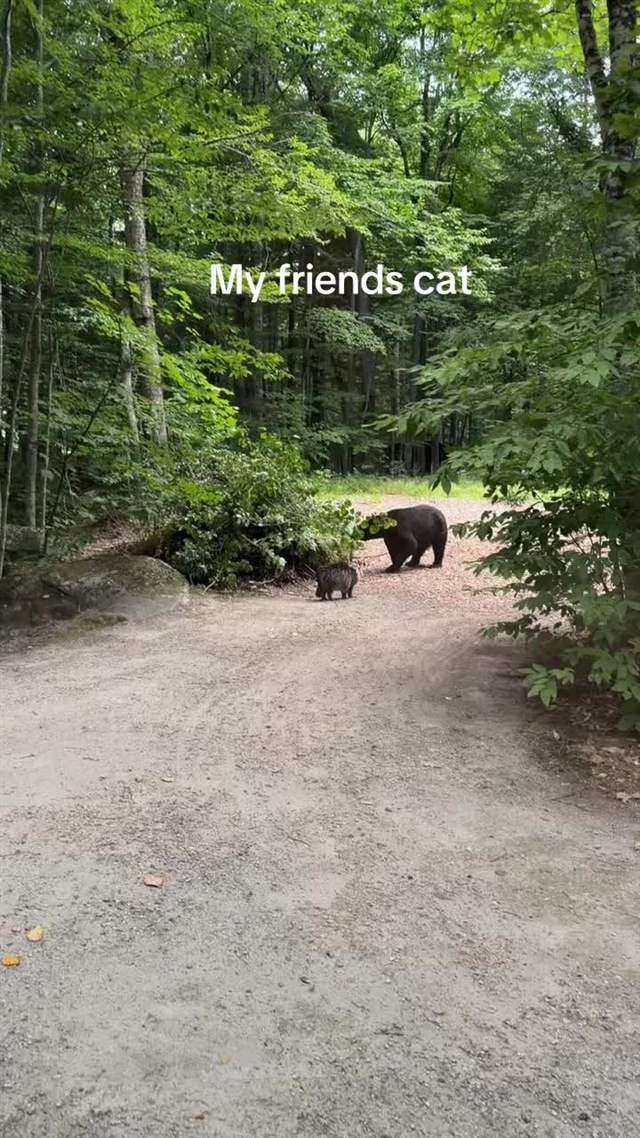
Here’s what the cat vs bear TikTok video actually shows, start to finish: a black-and-gray cat on a driveway, a black bear closing in from the treeline. Instead of running, the cat plants itself, arches its back, and puffs its fur out to look as big as it possibly can. The bear closes the last few feet and swipes. The cat swipes back, catching it across the nose. The bear rears up, hesitates, and retreats. Four seconds, maybe five. No slow build, no lucky break, just a direct confrontation with a clear winner.
@statbeauty_michelle ♬ original sound – STAT Beauty By Michelle
Who posted it, and how big it got
@statbeauty_michelle posted it, filmed on a property in New Hampshire, and the internet did the rest. It’s past 14 million views now, propelled less by the original account’s own following than by an avalanche of reposts and reaction stitches.
Entertainment and outdoors outlets picked up the cat vs bear TikTok video through the second week of August 2026, and PETA showing up in the comments is usually a decent signal that a piece of animal content has escaped the usual TikTok-animals bubble and gone properly mainstream. One thing worth flagging: the cat’s name gets reported differently depending on which secondhand write-up you read, and the original account hasn’t confirmed one, so this piece sticks to what’s actually verifiable from the video and the account itself rather than repeating a detail nobody’s nailed down.
Why wildlife experts say this isn’t as shocking as it looks
Scroll the comments on any cat vs bear TikTok video and you’ll find the same reaction on repeat: disbelief that a ten-pound animal would take on something many times its size. Wildlife researchers see it differently.
Black bears, per the North American Bear Center, rank among the more timid large predators in North America, and the reason traces back further than you’d guess: they evolved alongside genuinely dangerous competition, saber-toothed cats, American lions, dire wolves, short-faced bears, all of it extinct for roughly 12,000 years now. That long stretch of losing to bigger, meaner animals wired black bears with a strong default: retreat from anything that pushes back with confidence, rather than start a fight nobody needs to have.
None of this is really about one brave cat. Bear-safety guidance for homeowners in bear country says the same thing about small, loudly barking dogs, often enough on their own to send a black bear back into the treeline. A cat that puffs up, holds its ground, and strikes instead of fleeing is triggering that exact same response: the bear decides confrontation isn’t worth it and bails. Call it what it actually is. The cat didn’t “win” a fight in any conventional sense, because the bear never wanted one to begin with. It just lost its only reason to keep pushing forward.
Is the New Hampshire cat the first to pull this off?
No, and that’s part of what makes this cat vs bear TikTok video worth taking seriously as a pattern rather than a one-off fluke. In June 2026, a tuxedo cat in Quesnel, British Columbia, did almost the exact same thing: TikTok account @mydogslifebuddy posted footage of the cat charging a black bear that had wandered into the family’s backyard, sending it scrambling back over the fence into the forest. CTV News Vancouver picked up the story independently, and the account’s owner noted the same bear had been spotted in the yard two years earlier, back when there wasn’t a cat around to chase it off.
The Quesnel video topped out around 300,000 views, a fraction of what the New Hampshire clip has pulled in, but the behavior lines up almost exactly: a small, confident cat, a black bear that backs off rather than pressing the confrontation. Two data points don’t make a scientific trend, but they do make this cat vs bear TikTok video read less like a fluke and more like a second documented case of something wildlife researchers already expected black bears to do.
What the cat vs bear TikTok video shows vs. what experts recommend
What the video shows
- The cat holds its ground and puffs up instead of running
- The bear swipes once, then backs off entirely
- The clip is framed online as the cat “winning”
- 14M+ views treat the moment as pure entertainment
What wildlife experts actually say
- Standing tall and looking larger is a real, documented deterrent for black bears, but it works far more reliably for humans than for pets
- Consistent with black bears’ generally avoidant temperament; black bears attack roughly one person per year across North America, versus about eleven for grizzlies
- Every bear encounter is unpredictable regardless of how this one ended. This outcome isn’t a guarantee
- Experts don’t recommend letting pets approach or confront wildlife, even when the odds are statistically in the pet’s favor
That distinction deserves more credit than the comment section usually gives it. The video’s genuinely funny, and the cat’s confidence is real. But the responsible read isn’t “cats can handle bears.” It’s that this particular bear did what most black bears do in most encounters: back down rather than escalate. A cornered bear, a different bear, a mother with cubs nearby, any of those could go very differently, and no outdoor pet should get treated as safe around wildlife just because one cat vs bear TikTok video ended well.
For more on how a single TikTok clip turns into a full-blown internet moment almost overnight, see our coverage of the 365 Buttons trend, another case of one small, specific piece of content snowballing far past its original audience.
Quick answers
Is the cat vs bear TikTok video real? Yes. It’s an unedited clip posted by TikTok account @statbeauty_michelle, filmed on a property in New Hampshire, and it has been verified and reshared by multiple outlets since posting.
Who posted the cat vs bear TikTok video? TikTok user @statbeauty_michelle. The account hasn’t publicly disclosed further identifying details about the cat.
Are black bears usually scared off by cats or small pets? Often, yes. Black bears are naturally avoidant and are frequently deterred by confident, loud, or aggressive-seeming pets, including small dogs, though outcomes are never guaranteed.
Should I let my pet confront a bear like this? No. Wildlife experts consistently advise against letting pets approach or engage with bears. This video had a good outcome, but bear behavior is unpredictable, and no encounter should be treated as low-risk.
Has a cat done this before? Yes. In June 2026, a cat in Quesnel, British Columbia did something similar, chasing a black bear out of a backyard in a video picked up by CTV News Vancouver. The New Hampshire cat vs bear TikTok video isn’t the only documented case of a house cat facing down a bear and winning.
Background on black bear behavior and attack statistics referenced above comes from the North American Bear Center. Additional reporting on the video itself is available via OutKick.