

What Is a “Velcro Dog”? TikTok’s Clingy-Pup Trend, Explained (2026)
Credit: @digitdax/TikTok
A velcro dog is TikTok’s name for the pet that will not leave your side. It follows you from the kitchen to the bathroom, sits on your feet while you brush your teeth, and treats a closed door like a personal insult. Search the term on TikTok and the clips pile up fast: dogs wedged under a desk chair, dogs draped across a shoulder mid-selfie, dogs staring through the shower door like something terrible is about to happen. The label sounds like a joke about clinginess. Veterinarians say there is a real, sometimes serious behavioral story sitting underneath it.
This site’s Animals category has stayed thin since a fearless cat faced down a bear on a New Hampshire driveway and became this site’s first real Animals story. A velcro dog is a very different kind of animal moment: less a single viral clip than a recurring, years-old label that keeps finding new dogs to attach itself to.
What to know:
- “Velcro dog” describes a dog that sticks unusually close to its owner, following from room to room and struggling to settle when it can’t.
- The term is not a 2026 invention. Pet-care outlets and TikTok creators have used it for years, and it keeps resurfacing in new viral clips rather than arriving as a single fresh moment.
- Vets draw a hard line between a true velcro dog, which manages fine once its person actually leaves, and separation anxiety, which does not.
- Certain breeds, including Vizslas, Cocker Spaniels, Cavalier King Charles Spaniels and Maltese, show up again and again on vet-written velcro dog lists because of what they were originally bred to do.
- Published research adapting a classic human-infant attachment test to dogs found most dogs test as “securely attached” to their owner, at rates close to what shows up in human toddlers.
In this article
What “Velcro Dog” Actually Means
The comparison is literal. A velcro dog sticks to its owner the way the fastener sticks to itself, close, constant, and hard to peel off without a little resistance. Dog behavior sites describe it as a dog with “a strong desire to stay close to their humans,” happiest when it is touching you or within arm’s reach of you.
On TikTok, the term shows up as both a caption and a small genre of its own. Creators post “signs you have a velcro dog” checklists, POV clips of a dog physically climbing into frame, and straight documentation of a dog parked on someone’s feet while they cook. One recent example, from a dachshund account called Digit & Pip, captioned a clip simply: “Shout out to velcro dogs and their equally as clingy owners.” It is tagged #velcrodog along with a string of dachshund-specific tags, and it plays the behavior for warmth rather than concern.
@digitdax Shout out to velcro dogs and their equally as clingy owners! ❤️😂 #dogpov #povdog #velcrodog #dogfacts #dachshunduk #sausagedoguk #sausagedogcentral
♬ Turning Page (Instrumental) – Sleeping At Last
That mix, real behavior treated as a running joke, is most of what #velcrodog content actually is. The vet-written explainers sitting underneath the trend are where the more substantive velcro dog story lives.
Is This a New TikTok Trend, or an Old Term Having a Moment?
It would be easy to write this up as a fresh 2026 TikTok trend. That would not be honest. “Velcro dog” is an old piece of pet-owner vocabulary that TikTok adopted rather than invented, and the platform’s own content confirms it.
Independently verifiable #velcrodog videos go back years, not months. A staffy-focused clip using the tag dates to 2024. A cockapoo account’s “6 signs you have a velcro dog” post also dates to 2024. The Digit & Pip dachshund clip quoted above dates to 2023. None of these were traced through secondhand claims; each one was checked directly against TikTok’s own oEmbed system, which confirms a video is real and embeddable without relying on a caption or a third party’s description of it.
Pet-care publishers were writing about velcro dogs before most of these videos existed. Explainers on the term’s meaning, causes and breed patterns run across veterinary and pet-care sites with no single origin date attached, the kind of steady, evergreen coverage a genuinely new phrase does not get. TikTok did not start the “velcro dog” conversation. It gave an existing one a much bigger stage and a constant supply of new dogs to feature.
One honest limit worth stating directly: TikTok does not publicly display a verifiable, independently checkable count of how many videos carry the #velcrodog tag, and this site could not confirm a specific figure against TikTok’s own tools or a credible outlet that had done the same. What is verifiable is the pattern, real, tagged videos using the term every year since at least 2023, plus years of pet-behavior writing that predates TikTok’s version of it entirely.
Real Velcro Dogs on TikTok
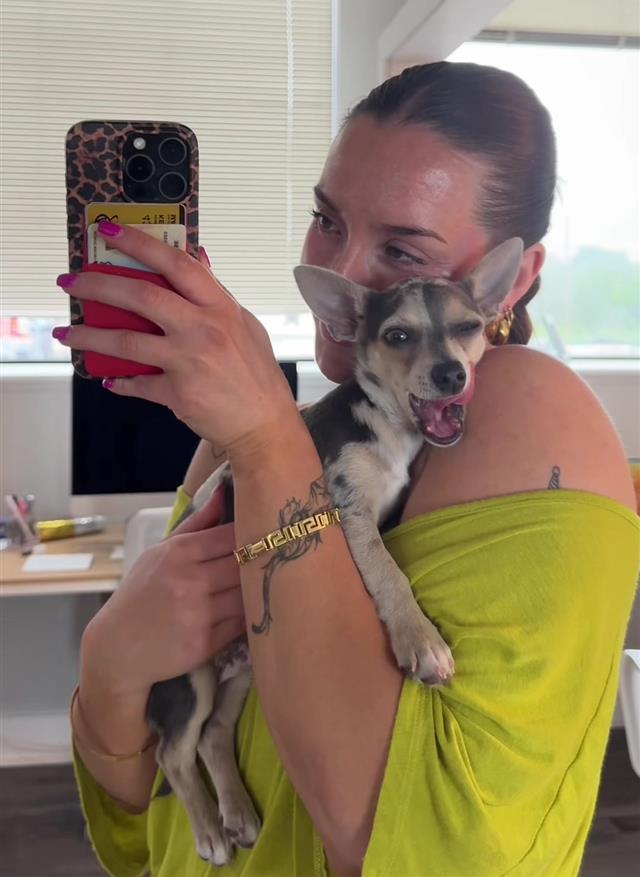
The Digit & Pip dachshund clip above is one real, current example. Here is a second, from a chihuahua account, showing exactly the kind of full-body cling the term describes.
@kennedyjuneco just a few memories made so far 💚 #chihuahua #chihuahuastiktok #chihuahuapuppy #newpuppy #newpuppycheck #velcrodog
♬ The Kite Luisa Marion – Luisa Marion
The account, run by a new chihuahua owner, tags the clip #velcrodog directly and posts more of the same: a puppy that wants to be held, carried and pressed against its owner’s chest rather than left to explore on its own. It is the exact behavior every velcro dog explainer describes, just captured in real time instead of summarized.
Newsweek has covered the same behavior repeatedly as a recurring human-interest story rather than a one-time trend piece. In one 2025 report, a Florida TikToker named the specific moment her dog interrupted her filming to climb onto her chest, “he’s right there, having a velcro dog be like that,” in a clip that reached roughly 3.5 million views and more than 671,000 likes. Newsweek has run similar stories about other individual velcro dogs since, evidence that this is a standing content category the outlet returns to, not a single viral flashpoint it covered once.
Why Some Dogs Are Wired to Be Velcro Dogs
Veterinarians point to a small handful of real causes rather than one explanation. The clearest is breeding history. In a January 2026 explainer for PetMD, veterinarian JoAnna Pendergrass, DVM, wrote that sporting breeds like Vizslas and Labrador Retrievers “were bred to work closely with people,” while companion breeds such as Shih Tzus and Cavalier King Charles Spaniels have “been selected for their desire to be close to their people.” In other words, a lot of this behavior is a dog simply doing what its breed was built to do.
Reinforcement is a second, less obvious factor. Pendergrass’s piece points out that owners often train the behavior without meaning to: “If you always give your dog food when they follow you into the kitchen, or if you pet them every time they lie next to you, you’re teaching your dog that following you leads to some type of reward.” The behavior isn’t only born into a dog. It can be built one snack at a time.
The same explainer lists two causes worth taking seriously rather than laughing off: sudden new clinginess in an older dog can signal illness or cognitive decline, and stress or generalized anxiety can produce velcro-style following that has nothing to do with breed or habit. Neither is the fun version of the trend, and both are reasons a sudden behavior change is worth mentioning to a vet rather than filing under “cute.”
Breed reporting backs up the pattern from a different angle. Newsweek’s November 2025 roundup of velcro dog breeds quotes veterinarian Dr. Liza Cahn on the Vizsla specifically: the breed is “often referred to as velcro dogs” and is prone to “separation anxiety and destructive behaviors” without enough closeness and stimulation. Two independent vets, writing months apart for two different outlets, land on the same underlying explanation: this is largely inherited temperament, occasionally complicated by real anxiety.
Velcro Dog or Separation Anxiety? The Difference That Matters
This is the part cute compilation clips tend to skip, and it is the actual substance behind the trend. A velcro dog and a dog with separation anxiety can look identical while their owner is home. The difference shows up the moment the owner leaves.
A true velcro dog wants to be near its person constantly while that person is around, but settles reasonably well once they’re gone. Separation anxiety is a distinct, more serious condition: panic at departure, destructive behavior, pacing, drooling or vocalizing while alone, and frantic, hard-to-calm greetings even after a short absence. Pendergrass’s explainer draws the line plainly, treating ordinary velcro dog behavior as something that “can make wonderful companions” on its own, while flagging real concern only once clinginess is paired with distress or destruction during separation.
The Newsweek breed piece makes the same distinction from the trainer’s side. Jennifer, head dog trainer at Top Paw K9 Academy, is quoted in that same article discussing how to manage separation anxiety specifically, a different, more structured intervention than anything a velcro dog without true anxiety would need. The standard approach trainers use for real separation anxiety starts small: short, low-stakes practice absences that build up gradually, rather than asking an anxious dog to tolerate a full day alone right away.
Put simply: if your dog just wants to be near you and is fine once you’re out the door, that’s a velcro dog. If your dog panics, destroys something, or can’t calm down the moment you leave, that’s a separate, diagnosable condition that benefits from professional help.
The Real Science Behind Dog Attachment
The velcro dog conversation is not purely anecdotal. Researchers have adapted a well-established human-infant test, the Strange Situation Procedure, originally built by developmental psychologist Mary Ainsworth, to measure how dogs attach to their owners.
In a study published in the journal Attachment & Human Development and hosted on the National Institutes of Health’s PubMed Central archive, researchers ran 59 adult dogs and their owners through a version of that test: a mildly stressful sequence of separations and reunions involving both the owner and a stranger. The dogs’ behavior classified into secure and insecure attachment patterns at roughly the same proportions researchers see in human toddlers tested the same way, around 61% secure and 39% insecure.
Dogs in the study sought contact with their owner more than with a stranger after a separation, and explored and played more freely when their owner was present than when only the stranger was in the room. The study also found that an owner’s sensitivity to their dog during the test meaningfully predicted whether the dog scored as securely or insecurely attached. A velcro dog, on this evidence, is not just a quirky label. It sits on a real, measurable spectrum of dog-owner attachment that researchers can actually test for.
Breeds Most Likely to Become Velcro Dogs
No breed is guaranteed to be a velcro dog and any dog can develop the behavior regardless of pedigree. That said, the same names come up repeatedly across vet-written breed guides, usually tied to a specific job the breed was originally developed for.
- Vizsla: nicknamed the “Velcro Vizsla” in dog-owner circles; bred as a close-working hunting companion, per veterinarian Dr. Liza Cahn’s comments to Newsweek.
- Cocker Spaniel: another close-working hunting breed; PetMD’s veterinary explainer specifically cites sporting breeds like this one as “bred to work closely with people.”
- Cavalier King Charles Spaniel: a companion breed selected across generations specifically for a desire to stay near its person, per PetMD.
- Maltese: a toy companion breed with the same close-companionship breeding history as the Cavalier.
- Golden Retriever: a people-oriented sporting breed frequently listed alongside Vizslas and Labradors in breed roundups like this one.
- Labrador Retriever: named directly by PetMD as a sporting breed bred to work in close partnership with its handler.
Mixed breeds and dogs outside this list show up constantly in #velcrodog content too, the chihuahua and dachshund featured above among them. Breed can load the dice toward velcro dog behavior. It does not decide the outcome on its own.
When Clinginess Actually Needs a Vet or Trainer
For most dogs tagged #velcrodog on TikTok, nothing here is a real problem. Wanting to be close to your favorite person is, as multiple vets quoted above put it, a normal and often welcome trait rather than a disorder to fix.
A few situations are worth a real conversation with a professional rather than a shrug. A previously independent adult dog that suddenly becomes a velcro dog, especially an older dog, is worth a vet visit to rule out pain, illness or cognitive decline. A dog that destroys furniture, injures itself trying to escape, or barks and howls for long stretches specifically when left alone has moved past ordinary clinginess into separation anxiety, and that calls for a certified trainer or veterinary behaviorist rather than a TikTok hack. Everything in between, a dog that just likes to be near you, follows you around, and settles down once you’re gone, is exactly what the term was built to describe in the first place: a velcro dog, nothing more urgent than that.
Quick answers
Is “velcro dog” an official behavioral term?
It’s not a formal clinical diagnosis, but it’s a widely used description among veterinarians, trainers and pet-care publishers for a dog that seeks constant closeness with its owner.
Is it bad for a dog to be a velcro dog?
Usually not. Vets describe ordinary velcro dog behavior as harmless and often a sign of a strong bond, distinct from the panic and destruction that mark true separation anxiety.
Which breeds are most likely to be velcro dogs?
Vizslas, Cocker Spaniels, Cavalier King Charles Spaniels, Maltese, Golden Retrievers and Labrador Retrievers appear most often on vet-written velcro dog breed lists, largely because of what those breeds were originally bred to do.
Is the velcro dog trend new in 2026?
No. The term predates its current wave of TikTok popularity by years, and verified #velcrodog videos date back to at least 2023, alongside pet-care coverage of the behavior that’s older still.