TikTok Likeness Detection: Global Rollout and a New Tool to Check AI Content
TikTok announced on Thursday, November 19, 2026 that it is “starting to globally roll out Likeness Detection,” an opt-in tool that helps eligible creators find and flag AI-generated content on TikTok that may use their likeness without their consent. According to TikTok’s Newsroom post, the same announcement adds a second tool that lets anyone check whether an image or video was made or edited with TikTok’s own AI creation features.
This article sets out how TikTok Likeness Detection works, who can use it, what the new checking tool does and what TikTok has not said. Facts come from TikTok’s November 19 Newsroom post, its November 20 Safety and Innovation Forum post, TikTok’s Transparency Centre page for the checking tool and, for the earlier test, RouteNote.
What to know:
- TikTok Likeness Detection: an opt-in tool, rolling out globally, that helps eligible creators find and flag AI-generated content that may use their likeness without consent.
- The sign-up: eligible creators verify their ID with a “trusted third-party partner,” and TikTok says it does not keep ID documents.
- The checking tool: anyone can upload an image or video, with no TikTok account, to see whether TikTok’s AI creation features generated or edited it.
- The signals: the checking tool looks for C2PA Content Credentials and for VeraDura, TikTok’s proprietary invisible watermark.
- The gap: TikTok’s post does not list countries, dates or eligibility thresholds for TikTok Likeness Detection.
In this article
What TikTok Likeness Detection Is
TikTok describes TikTok Likeness Detection as “an opt-in tool that helps eligible creators find and flag AI-generated content on TikTok that may use their likeness without their consent.” It is one of two tools in the November 19 post, which TikTok presents as “two new tools that give our community more clarity and control as they create and engage with AI on TikTok.”
TikTok says it already has “rules against harmful and misleading AI-generated or significantly modified by AI content” and that it removes “more than 99%” of content that breaks its rules before anyone reports it. In its words, TikTok Likeness Detection “builds on these efforts by giving creators a more direct way to find and act on it themselves.”
Anyone, whether or not they use TikTok, can also report nonconsensual AI-generated content through TikTok’s privacy reporting form, according to the post. That route is separate from the new tool.
How TikTok Likeness Detection Works
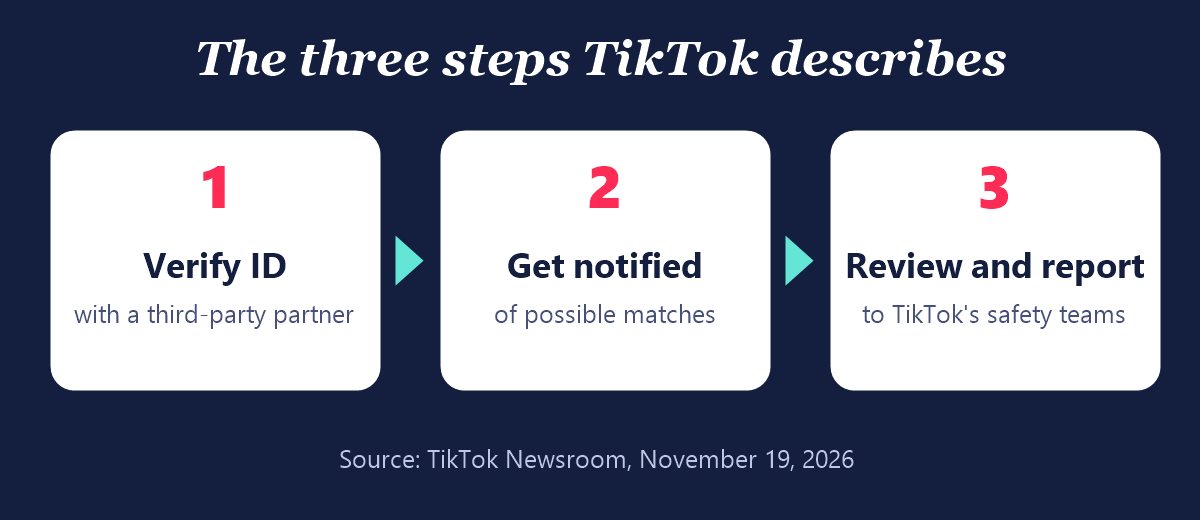
TikTok says TikTok Likeness Detection “works in three simple steps”:
- Sign up: eligible creators sign up by verifying their ID with a trusted third-party partner.
- Get notified: they are notified when content and accounts on TikTok may be using their likeness, and can review them within the tool.
- Report: they can report content directly to TikTok’s safety teams.
TikTok adds that content which violates its community guidelines “against harmful, misleading or nonconsensual depiction of private individuals will be removed.” The post does not say what happens to flagged content that does not break those guidelines, and it does not give a review time.
On privacy, TikTok says TikTok Likeness Detection “is designed to minimise data collection and preserve privacy, and TikTok does not keep ID documents.” It points readers to its Help Centre for more.
Who Can Use TikTok Likeness Detection
The post says the tool “is available to eligible creators and public figures, including Government, Politician, or Political Party Accounts (GPPPAs).” It does not define “eligible,” and it does not say how many creators have access today. It says TikTok is “starting to” roll the tool out globally, which describes the start of a rollout, not a finished one.
TikTok Likeness Detection is not available to everyone who uses the app. A creator or public figure who wants it signs up through the verification step above, and TikTok decides who is eligible.
How TikTok Likeness Detection Began as a US Test
TikTok Likeness Detection did not appear for the first time on November 19. RouteNote reported on July 21, 2026 that TikTok had “quietly begun testing” a deepfake detection tool for “a small group of US creators,” with “no word yet on when it could become more widely available.”
RouteNote, citing Digital Music News, said eligible creators opted in by verifying their identity through Jumio, an identity verification company, with a live selfie scan and an ID check. It said TikTok told The Verge it does not retain users’ ID documents and that facial information is used solely for likeness matching and identifying potential unauthorised uses.
The November post describes the same sign-up idea in general terms, “verifying their ID with a trusted third-party partner,” without naming a company. This article therefore attributes the Jumio name to the July reporting only.
The New Tool to Check Content Made With TikTok AI
The second tool is a checker open to everyone. TikTok says it is “launching a new transparency tool that lets anyone check for themselves.” People “can upload an image or video to see whether it was generated or edited with TikTok’s AI creation features, even if they don’t have a TikTok account.” TikTok says the tool is available now through its Transparency Centre.
It looks for two signals, which TikTok says it adds to content made with its AI tools:
- C2PA Content Credentials: metadata that carries information about how content was made. TikTok says that in 2024 it “became the first video platform to adopt C2PA Content Credentials,” which it automatically adds to AI-generated content made with its tools.
- VeraDura: TikTok’s “proprietary invisible watermark,” which it describes as “more durable and harder to remove.”
TikTok explains why it built a separate checker. Labels work “when the platform where content ends up reads those signals,” but “as content is downloaded, reshared and edited, that information can be lost along the way.” TikTok also says its labelling work has helped it label “over 5 billion AI-generated videos” on its platform to date.
The Transparency Centre page lists what can be uploaded, one file at a time. Images can be JPEG, PNG, JPG or WebP up to 20 MB, and videos can be MP4, MOV, WebM or AVI up to 100 MB. The page’s opening line says the tool checks whether “an audio, image or video” was made with TikTok AI, while its upload table lists only image and video formats. TikTok says it deletes an uploaded file “immediately after showing you the result” and never uses it to train models.
What the Checking Tool Cannot Tell You
TikTok’s own page is direct about the limits. The tool “only covers Content Credentials added by TikTok.” For credentials from other platforms, it points to a separate site, verify.contentauthenticity.org.
When the tool finds no signal, TikTok says that “could mean the file wasn’t made with our AI tools, generated by another platform’s AI tools, or the content was not AI-generated.” It adds that “no AI detection tool is 100% foolproof,” and gives three reasons a TikTok-made file might show weak signals: the C2PA metadata was stripped, the invisible watermark was degraded, or the file predates these signals. If a file was later modified by other platforms, TikTok says the tool “cannot identify those changes.”
The page also says results are “for general informational purposes only” and “should not be relied upon as legal, compliance, or other professional advice.” In short, a positive result points to TikTok’s AI tools, and a negative result does not prove a file is real.
Other AI Controls TikTok Lists
The November 19 post places both tools among what it calls TikTok’s “continued investment in giving our community more clarity and control over their AI experience.” It lists three other items:
- AI literacy: an in-app AI literacy hub, launched in July, that TikTok says “has helped more than 4 million people build practical skills for spotting AI-generated content.”
- Feed controls: a revamped Manage Topics feature that “lets people adjust how much AI-generated content they see in their For You feed,” alongside tools like Not interested and keyword filters, which TikTok says were “used by more than 79 million people in the EU in the first half of 2026.”
- Industry collaboration: TikTok says that as a member of the C2PA Steering Committee it continues to “help drive industry adoption of Content Credentials.”
For TikTok’s own account of how the feed picks videos, see this site’s guide to how the For You feed works, and for earlier rules on AI labels, the explainer on TikTok AI transparency in 2026.
Where the Announcement Was Made
TikTok’s November 20 post says it shared the updates “yesterday” at its third Safety and Innovation Summit, which it describes as a gathering of “journalists and external experts.” A separate TikTok post on the same event says it was held in London, with journalists, creators and experts from across Europe.
Tom C. Varghese, Artificial Intelligence Lead, Global Public Policy at TikTok, is quoted in that post: “One of the most exciting things about AI is how it gives people more ways to bring their ideas to life. But to create and explore with confidence, people need to trust what they see and know their likeness is protected. We’ve spent years building that foundation through our policies, labeling technology and AI literacy work, and today’s updates are the next step.”
The forum post lists other topics from the event, including a redesigned Family Pairing, an Educator’s Guide, a Discovery on TikTok report, food content on the platform and preparations for upcoming European elections. This article covers only the AI tools.
What TikTok Has Not Said About TikTok Likeness Detection
TikTok’s announcement leaves several practical questions open. It does not list the countries where TikTok Likeness Detection is available now or the dates it will reach others. It does not define which creators are “eligible.” It does not say how many creators are in the tool, how matches are found, how many reports it expects or how long a review takes. It also does not name the third-party partner used for ID checks.
The same is true of the checker. TikTok gives file formats and size limits but no figure for how often it finds a signal, and it says plainly that results can miss content.
Frequently Asked Questions
What is TikTok Likeness Detection?
It is an opt-in tool TikTok began rolling out globally on November 19, 2026. It helps eligible creators find and flag AI-generated content on TikTok that may use their likeness without consent.
Who can use TikTok Likeness Detection?
TikTok says it is available to eligible creators and public figures, including Government, Politician, or Political Party Accounts. It does not define “eligible.”
Does TikTok keep ID documents for TikTok Likeness Detection?
TikTok says it does not keep ID documents and that the tool is designed to minimise data collection.
Can anyone check whether a file was made with TikTok AI?
Yes. TikTok’s transparency tool lets anyone upload an image or video, without a TikTok account, to look for C2PA Content Credentials and its VeraDura watermark. It covers only TikTok’s own AI tools.
Does a negative result mean a video is real?
No. TikTok says no detection tool is “100% foolproof” and that a missing signal can mean the file came from another platform’s AI tools, was not AI-generated, or lost its signals after being edited or reshared.
Sources: TikTok Newsroom, November 19, 2026, TikTok Newsroom, November 20, 2026, TikTok Transparency Centre and RouteNote, July 21, 2026. TikTok, VeraDura and C2PA belong to their owners; this site is independent and not affiliated with any of them.