TikTok Music Impact Report: 94% of 2025 Global 200 Songs Went Viral on TikTok First
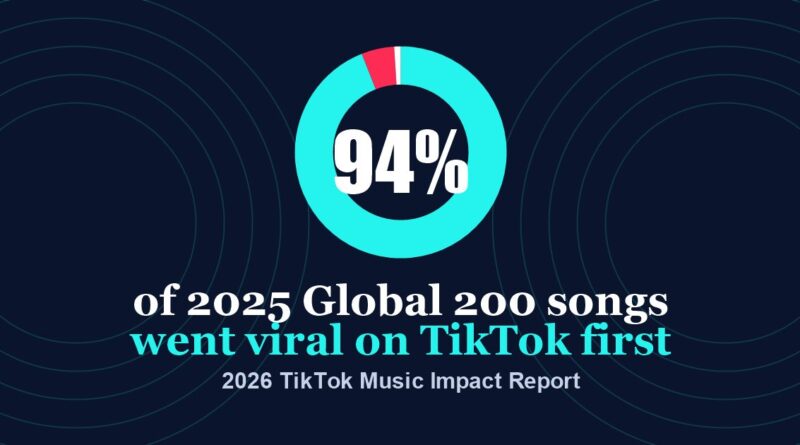
TikTok says 94% of the songs that entered the Billboard Global 200 chart in 2025 went viral on its platform before they charted. The figure comes from the 2026 TikTok Music Impact Report, which was prepared by the music data company Luminate and published on Wednesday, November 18, 2026, according to TikTok’s own Newsroom post, Music Business Worldwide and Music Week.
This article sets out what the TikTok Music Impact Report found, how its chart analysis was built, what TikTok’s music executive said about it and who produced the data. Every number below is attributed to the report as described by TikTok’s Newsroom post or by those two trade publications.
What to know:
- The headline: in the TikTok Music Impact Report, 94% of songs that entered the Billboard Global 200 in 2025 went viral on TikTok first, up from 84% in the report for 2024.
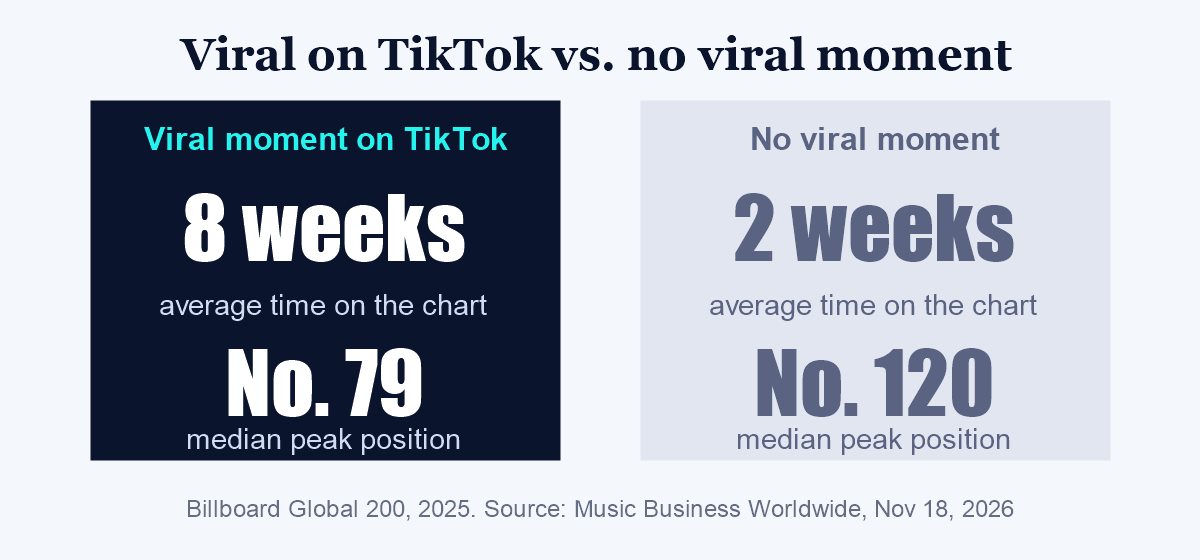
- Staying power: songs with a TikTok viral moment averaged about eight weeks on the chart, against about two weeks for songs without one.
- Streams: 43% of 516 artists analyzed showed a strong or moderate positive link between TikTok views and US on-demand audio streams.
- Fans: 45% of US TikTok users in the surveys said they use the platform to discover new music and artists.
- Four times longer: TikTok’s Newsroom post says songs that go viral on TikTok spend four times longer on the Billboard Global 200 than those without a viral moment.
- The source: the study was commissioned by TikTok, and the TikTok data in it was supplied by TikTok.
In this article
What the Report Says
Music Business Worldwide reports that the study “concludes that the app ‘remains a meaningful driver of music discovery, monetization, chart success, music fandom and culture.'” Its headline finding, in the publication’s words: “TikTok says that 94% of songs that entered the [Billboard] Global 200 in 2025 went viral on its platform before they charted.”
The TikTok Music Impact Report is an annual publication. Last year’s edition of the TikTok Music Impact Report put the same measure at 84% for 2024, and the 2026 report treats 94% as the new figure. Music Week describes the result as “Almost every song to enter the Global 200 in 2025 (94%) had gone viral on TikTok first.”
The full split is as follows, according to Music Business Worldwide. Another 5% of songs went viral on TikTok at the same time as, or after, entering the chart. Just 1% had no TikTok viral moment tied to their charting. In the 2024 report, that last group was 4%.
The Chart Numbers
The TikTok Music Impact Report compares songs that had a TikTok viral moment with songs that did not. Per Music Business Worldwide, songs that went viral on TikTok “spent an average of eight weeks on the Billboard Global 200 in 2025, compared with two weeks for songs without a viral moment.” Music Week states the same result as four times longer on the chart.
Peak position follows the same pattern. Viral tracks reached a median peak of No. 79 on the chart, versus No. 120 for non-viral tracks. A median peak is the middle value of the highest positions the songs reached, so half of the songs in each group peaked above that number and half below it. On the Global 200, a lower number is a higher position.
Neither outlet gives a list of the songs behind the 94%. The TikTok Music Impact Report is described as a count of chart entrants, not a ranking of which songs went viral or how large each viral moment was.
How the Chart Analysis Was Done
Music Business Worldwide lists the scope of the chart analysis in the TikTok Music Impact Report. It “covered the period from March 11 to December 4, 2025, and excluded Christmas and holiday songs, for a total of 484 songs.” The weeks-on-chart comparison “was based on a narrower sample of 454 songs, which also excluded any song that charted in the second half of 2024, to account for recurrence.”
Last year’s edition used a different window. It analyzed the period from December 29, 2023, to September 26, 2024. That means the 84% and 94% figures cover different stretches of the chart year, which is worth keeping in mind when comparing them.
The TikTok Music Impact Report also says its TikTok data came from the company itself: “The TikTok virality and engagement data used in the study was provided by TikTok,” Music Business Worldwide writes, citing the report.
TikTok Views and Streams
A second section of the TikTok Music Impact Report looks at the link between TikTok activity and listening elsewhere. Luminate compared TikTok views with US on-demand audio streams across 2025 for a sample of 516 artists, which it says represent around two-thirds of US streaming volume.
- 43% of those artists showed strong or moderate positive correlations between TikTok views and on-demand audio streams, up from 33% in 2023.
- 74% of the fastest-growing artists, defined as those whose streams rose by 20% or more in the fourth quarter of 2025 versus the fourth quarter of 2024, showed that pattern.
- Music Week adds that the figure rises to 71% among artists whose streaming comes mainly from recent releases.
The TikTok Music Impact Report includes a caution. Across the whole market, correlations in 2025 were “effectively unchanged” from 2023, while more individual artists showed a correlation with TikTok. Luminate also says its 2025 figures cannot be compared with last year’s analysis, which used global consumption data and a different method.
A correlation means two measures move together. It does not show that one causes the other. TikTok’s Tracy Gardner said as much to Music Business Worldwide: “Correlation on its own doesn’t prove cause and effect, and Luminate is careful about that.”
What the Surveys Found
The consumer findings in the TikTok Music Impact Report come from two Luminate surveys, each of more than 4,000 US respondents aged 13 and over, conducted in May and June 2026. Music Business Worldwide lists these results:
- 45% of US TikTok users said they use the platform to discover new music and artists, compared with 39% of YouTube users, 36% of Instagram users and 28% of Facebook users.
- US music listeners on TikTok are 78% more likely than the US general population to use a paid music streaming subscription. The report puts Instagram at 72%, YouTube at 48% and Facebook at 48%. Last year’s report said 68%.
- 61% of US TikTok users who listen to music bought physical or digital music in the past year, and they spend 22% more on physical music than the average music listener.
- US TikTok users who buy music are 23% more likely than the average music listener to say supporting artists is important when deciding what form of music to buy. Those who listen to music are 28% more likely to say they buy merchandise to support artists.
- US TikTok users are 61% more likely than the average music listener to identify as members of a dedicated artist fan base, such as Swifties, BTS’ ARMY or the BeyHive. The report says that is more than users of any other major social platform.
- Among US TikTok users who engage with music on social media, 52% watch videos about artists, 47% follow artist accounts or fan pages and 39% listen to artists perform live, for example through social livestreams.
What TikTok Added in Its Own Post
TikTok published its own announcement of the TikTok Music Impact Report on November 18, 2026, headlined “94% of global hits went viral on TikTok first, reveals 2026 Music Impact Report.” The Newsroom post describes the research as “commissioned by TikTok from Luminate” and repeats the 94% figure, up from 84% in 2024.
The Newsroom post adds details on how the survey results are framed. In its words, 61% of US TikTok users who listen to music actively seek out new and emerging artists, which it says is 29% more likely than the average music listener. It also says 74% of US TikTok users who listen to music say TikTok helps them connect with a community of like-minded music fans.
- Paid streaming: US music listeners on TikTok are 78% more likely than the US general population to use a paid music streaming subscription, which the post says is a bigger over-index than music listeners on any other major social media platform.
- Future subscribers: US music listeners on TikTok who do not currently pay for streaming are 30% more likely than the average music listener to say they are likely to subscribe within the next six months.
- Purchases: 61% of US TikTok users who listen to music bought physical or digital music in the past year, more than users of any other major social media platform, and US TikTok users spend 22% more on physical music than the average music listener.
- Streaming link: Luminate’s analysis of 516 artists, representing roughly two-thirds of US streaming volume, found 43% showed strong or moderate positive correlations between TikTok views and on-demand audio streams in 2025, up from 33% in 2023.
Footnotes in the Newsroom post define two terms. The “fastest-growing artists” are those in the top growth quartile, with year-over-year streaming growth of roughly 20% or more. “Strong or moderate” correlation is defined as r above .4.
The Case Studies
The TikTok Music Impact Report includes case studies on sombr, Sienna Spiro, Pierce The Veil and Zara Larsson, according to Music Business Worldwide. Details the TikTok Music Impact Report gives for three of them:
- Pierce The Veil: their 2023 track “So Far So Fake” went viral on TikTok in July 2025. In the 12 weeks that followed, the band’s average weekly US on-demand audio streams across its catalog rose 75% year over year, for a cumulative 113 million additional streams.
- Zara Larsson: a video of a fan dancing onstage with her to her 2015 hit “Lush Life” went viral in November 2025, “sparking a TikTok trend that sent the track back onto multiple charts, according to the report.”
- sombr and Sienna Spiro: the report says sombr’s “Back to Friends” was the most-saved track of 2025 globally through TikTok’s Add to Music App feature, and that Spiro’s “Die on This Hill” was the most-saved track globally through the same feature in the year to April 2026.
TikTok’s Newsroom post gives more detail on two of them. It says sombr’s “Back to Friends” spent 82 weeks on the Billboard Global 200 following its viral success on TikTok, and that Sienna Spiro’s “Die on This Hill” became the most-saved track globally through Add to Music App over the year to April 2026. For Pierce The Veil, it says total US streams rose 75% year over year after “So Far So Fake” went viral, an additional 113 million streams in the 12-week post-viral period compared with the same 12 weeks a year earlier.
Both artists post on TikTok. Below is a clip from sombr’s account announcing the “Back to Friends” music video, followed by a performance clip of “Die On This Hill” from Sienna Spiro’s account.
Watch on TikTok: @sombr
Credit: @sombr/TikTok
Watch on TikTok: @siennaspiro
Credit: @siennaspiro/TikTok
Add to Music App lets a TikTok user save a song to a streaming service from inside the app. In April, according to Music Business Worldwide, TikTok said the feature had been used to save more than 6 billion tracks over the previous 12 months.
What TikTok Said
Tracy Gardner, TikTok’s Global Head of Music Business Development, said: “Every year, more of the world’s biggest songs start life on TikTok, and this latest report shows just how central our platform has become to global music success.”
Asked by Music Business Worldwide what drove the jump from 84%, Gardner answered: “A few things are happening at once. The first is that the industry has caught up with how fans actually discover music. Today, artists and their teams build TikTok into a launch from day one, and often before the song is even out.” She also credited the Add to Music App feature.
Discussing the TikTok Music Impact Report and the 1% of new chart entries with no viral moment, Gardner said: “It’s become genuinely rare for a song to be a global hit without TikTok being part of its story.” On staying power she said: “A viral moment gets a song noticed. What makes it last is participation.”
On the TikTok Music Impact Report, Jaime Marconette, VP of Music Insights and Industry Relations at Luminate, said: “TikTok’s role as a music discovery engine is statistically undeniable, driving both global music consumption and chart success.” He added: “It’s increasingly difficult to find high-growth artists whose success isn’t highly correlated with TikTok.”
Who Made the Report
TikTok’s Newsroom post and both outlets state the origin of the TikTok Music Impact Report plainly. Music Business Worldwide calls it “a new study commissioned by TikTok.” Music Week says “The report was commissioned by TikTok and prepared by music and entertainment data company Luminate.” The TikTok virality and engagement data was provided by TikTok. Luminate supplied the chart analysis, the streaming comparison and the surveys.
That makes the 94% in the TikTok Music Impact Report a figure from a study the platform paid for, using its own data on what counts as viral. Neither the outlets nor TikTok’s Newsroom post publish the definition of “viral” used in the study, and this article does not supply one. TikTok’s earlier report on 2024 used the same headline measure, so the year-to-year change is the part of the story TikTok highlights.
More on TikTok and Music
For how TikTok is promoting music in its own app right now, see the U2 TikTok experience for Carnaval De Luz and Daddy Yankee’s La Postal on TikTok SoundOn. For the live side of the music business, see TikTok LIVE Music: 46,000 UK creators went LIVE and Karol G’s TikTok LIVE premiere.
Frequently Asked Questions
What is the TikTok Music Impact Report?
The TikTok Music Impact Report is TikTok’s annual study of its role in music, prepared by Luminate. The 2026 edition was published on November 18, 2026, and covers chart data from 2025 plus surveys fielded in May and June 2026.
What does the 94% mean?
It means 94% of the 484 songs that entered the Billboard Global 200 between March 11 and December 4, 2025, excluding holiday songs, went viral on TikTok before they charted, according to the report.
Did the figure go up?
Yes. The TikTok Music Impact Report for 2024 said 84%. The two analyses covered different date ranges, so the comparison is approximate.
Who paid for the study?
TikTok commissioned it. Luminate prepared it, and the TikTok virality and engagement data came from TikTok.
Does going viral on TikTok cause a song to chart?
The TikTok Music Impact Report shows a link, not a cause. TikTok’s own executive told Music Business Worldwide that correlation “doesn’t prove cause and effect.”
Sources: TikTok Newsroom, November 18, 2026, Music Business Worldwide, November 18, 2026 and Music Week, November 18, 2026. Embedded videos belong to their posters. TikTok, Luminate, Billboard and the artists named belong to their owners; this site is independent and not affiliated with any of them.