TikTok Campus Hub: How It Works for College Students (2026)
If a group chat full of classmates you’ve never actually messaged just showed up in your TikTok inbox, or you’ve noticed a “Campus” option sitting in your profile settings, you’ve run into TikTok Campus Hub. It’s TikTok’s system for verified-student-only group chats and a school-specific feed, and as of September 2026 it’s live at more than 6,000 U.S. universities. Here’s how TikTok Campus Hub actually works, what it takes to get verified, and what happened the last two times a major platform tried something similar.
- What it is: TikTok Campus Hub combines Campus Groups (group chats of up to 300 verified classmates) and a College Feed (content from verified students at your school plus school-related posts)
- Launch date: April 30, 2026, built on top of Campus Verification, which TikTok launched in August 2025
- Verification: runs through a third-party service called UNiDAYS plus an academic email address, and it’s entirely optional
- Eligibility: available at more than 6,000 U.S. colleges and universities as of this writing
- The track record: Facebook Campus shut down in 2022 and Yik Yak has a long, documented history of abuse, but for genuinely different reasons than the “fake students got in” story that’s already circulating about both
In this article
What Is TikTok Campus Hub?
TikTok Campus Hub is the platform’s dedicated space for verified college students, and TikTok officially launched it on April 30, 2026. TechCrunch broke the news the same day, and Social Media Today’s own report confirmed the same core details within hours.
It isn’t a standalone app. TikTok Campus Hub lives inside the main TikTok app, built directly on top of a feature called Campus Verification, which TikTok launched in August 2025. Campus Verification let students add their school and graduation year to their profile and browse a list of other verified students at the same school. TikTok Campus Hub adds two real, functional features on top of that existing verification layer: group chats and a dedicated feed.
The timing wasn’t random either. TechCrunch’s reporting frames the April 30 launch as arriving right before summer break scatters campus communities, positioning TikTok Campus Hub as a way to keep classmates in touch, plan reunions, or organize around fall move-in, before students are back on campus in person.
How to Verify Your Student Status, Step by Step
Access to TikTok Campus Hub depends entirely on Campus Verification, TikTok’s process for confirming you’re an actual student at a specific school. Based on TikTok’s own rollout and reporting on the verification flow, here’s how it works.
- Open your TikTok profile and tap “Add school” (or the equivalent option in your profile settings).
- Enter your university’s name and your graduation year.
- Provide your academic email address (your .edu-style school email) to confirm you’re actually enrolled there.
- TikTok runs that verification through UNiDAYS, a third-party student-verification service the company partnered with specifically to add an extra checking layer beyond the email address alone.
- Once verified, your school and graduation year display on your profile, and you can browse your school’s page, filter classmates by graduation year, and unlock TikTok Campus Hub’s group chats and feed.
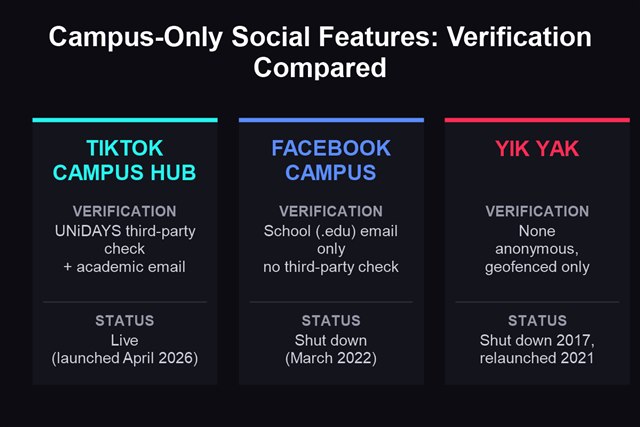
UNiDAYS is the same kind of infrastructure that already handles student-discount verification for retailers, not a system TikTok built from scratch. That’s a real, meaningful difference from how Facebook originally verified its own campus-only product, which relied purely on a school email address with no independent third-party check behind it, a distinction worth keeping in mind heading into the track-record section below.
What You Get Once You’re Verified
Once Campus Verification is complete, TikTok Campus Hub unlocks two distinct features. They work differently and solve different problems, so it’s worth separating them out.
Campus Groups
Campus Groups are group chats capped at 300 members, and every member has to be a verified student at that same school. TikTok’s own framing, per TechCrunch’s reporting, is that they’re built for staying in touch, planning reunions, or keeping a class or club’s conversation going over the summer when everyone’s scattered.
A 300-person cap puts Campus Groups closer to a large club or a full course section than a small friend-group chat. That’s large enough for something like an entire dorm floor, a big lecture class, or a student organization, but still gated so no one outside that verified student population can join or read what’s posted.
College Feed
The College Feed is a separate, personalized feed that mixes two kinds of content: posts from other verified students at your school, and content related to your university more broadly, official accounts, campus events, that kind of thing. It’s a distinct surface from the main For You feed, scoped specifically to your verified campus.
HerCampus described the pitch behind College Feed in a way that captures TikTok’s own framing well: campus friendships already run partly on “the funny TikToks we send to each other,” and the College Feed is TikTok’s attempt to formalize that habit into a real, school-specific feed rather than leaving it to individual DMs.
Which Schools Are Eligible, and What You Need
TikTok Campus Hub is available at more than 6,000 U.S. universities and colleges, a number that comes directly from TikTok’s UNiDAYS partnership and is confirmed consistently across TechCrunch, Social Media Today, and HerCampus’s own reporting. That’s a genuinely wide footprint, covering most accredited four-year schools and a large share of community colleges UNiDAYS already works with.
The real requirement isn’t the school so much as the email address. You need an active academic email account at an eligible institution to complete verification, so the feature doesn’t work for prospective students, recent graduates whose school email has already been deactivated, or people auditing a class without formal enrollment.
None of the coverage of TikTok Campus Hub’s launch mentions an age minimum specific to the feature itself, separate from TikTok’s standard account-age rules. Realistically, the academic-email requirement already limits this to people old enough to be college students, which functions as its own informal filter.
What Becomes Visible, and What You Can Control
Campus Verification is opt-in, not automatic. If you never tap “Add school,” none of your school affiliation, graduation year, or campus activity gets tied to your TikTok profile, and TikTok Campus Hub simply isn’t part of your account. Skipping the feature entirely is a real, functional privacy option, not just a technicality.
Once you do verify, your school and graduation year become visible on your public profile, and other verified students at your school can find you by browsing the campus directory or filtering by class year. That’s the entire point of the feature, connecting you to classmates, but it also means your campus affiliation is no longer private the moment you opt in.
That trade-off is a real one worth sitting with before verifying, not a hypothetical. Making a student’s campus and graduation year discoverable by anyone who also verifies at that school creates a genuine surface for unwanted contact, particularly for students who might have reasons to keep their location or school affiliation less publicly searchable. TikTok hasn’t published a dedicated set of granular privacy controls specific to Campus Hub beyond the basic opt-in itself, at least not in anything reported publicly as of this writing.
This site has covered TikTok’s data-privacy track record in more depth before, including a 4.5-billion-video dataset pulled from a private TikTok API that ended up on Hugging Face. That story is a different kind of privacy issue than campus verification, but it’s a useful reminder that opting into any feature that makes your identity more discoverable on TikTok carries some real downside risk alongside the convenience.
The Track Record: Facebook Campus and Yik Yak
TikTok Campus Hub isn’t the first attempt at a campus-gated social product, and it’s worth looking honestly at what happened to the two most obvious predecessors rather than just assuming history repeats. Both had real, well-documented problems. Neither failed for exactly the reason that’s already circulating about them.
Facebook Campus
Facebook launched Campus in September 2020 as a college-only pilot requiring a school email to join. Meta shut it down on March 10, 2022, after roughly 18 months, having only reached 204 participating schools. TechCrunch’s report on the shutdown quotes Meta’s own stated reason directly: “we’ve learned that the best way to support students is through Facebook Groups.”
Some coverage of TikTok Campus Hub’s launch, including analysis from We Are Founders, describes Facebook Campus’s shutdown as a direct result of non-students infiltrating the supposedly student-only space. That’s a clean, tidy explanation for why campus-gated products fail, but it isn’t what the contemporaneous reporting on the actual shutdown supports.
What the reporting from that period actually points to is a mix of low engagement and poor product placement. Tubefilter’s coverage notes Campus was buried inside Facebook’s “More” tab rather than getting its own app, which hurt discoverability so badly that plenty of eligible students likely never knew it existed. The same coverage points to fading demand as pandemic-era remote learning gave way to a return to in-person campus life, plus direct competition from Yik Yak in the same college-town audience Campus was chasing.
None of that is a story about verification breaking down and outsiders slipping in. It’s a story about a feature that didn’t get enough real usage to justify keeping it running, tucked into a menu most users never opened, competing against an app that was already winning the same audience for different reasons entirely.
Yik Yak
Yik Yak’s history is a genuinely different case, and it doesn’t fit the “verified students only, until it wasn’t” framing at all. Yik Yak, launched by two Furman University students in 2013, was never actually restricted to verified students in the first place. It was anonymous and geofenced to a roughly five-mile radius, meaning anyone with the app and a phone number, student or not, could read and post in a given area.
That’s a materially different design than either Facebook Campus’s school-email gate or TikTok Campus Hub’s UNiDAYS-backed verification. Yik Yak’s real problem wasn’t outsiders defeating a verification system, since there was no student-only space to defeat. It was anonymity plus hyperlocal proximity, a combination that made harassment feel immediate and threatening in a way non-local anonymous platforms didn’t.
The documented incidents were serious. Schools in Massachusetts were forced to evacuate twice over bomb threats posted to the app, and campus police at the University of Missouri arrested a user who posted threats of violence against Black students, a case that ended in a guilty plea to making a terrorist threat. Usage dropped roughly 75% between 2015 and 2016 as schools began blocking the app on campus wifi, and Yik Yak shut down in 2017 after Square paid roughly $1 million largely to acquire its engineering team, per TechCrunch’s reporting at the time. A fuller account of the app’s rise and collapse is in Failory’s case study.
The app has since relaunched, and reports of cyberbullying have followed it back, which tracks with the actual root cause: unmoderated anonymity in a small radius, not a broken verification wall. That’s a genuinely different lesson for TikTok Campus Hub than the Facebook Campus comparison offers. TikTok Campus Hub isn’t anonymous. Every post and message in a Campus Group is tied to a verified, named account, which structurally rules out the specific failure mode that sank Yik Yak.
How Is TikTok Campus Hub Actually Doing So Far?
Honestly, there isn’t much hard data to report here yet. As of this writing, no outlet covering TikTok Campus Hub, including the outlets that broke the original launch story, has published adoption numbers, verified-student counts, or documented incidents specific to the feature since it launched in April 2026. TikTok itself hasn’t put out a follow-up Newsroom post with usage figures either.
What exists instead is analysis and speculation, and it’s worth being clear about which is which. We Are Founders argues TikTok Campus Hub starts from a stronger position than Facebook Campus did, since it’s a feature layered into an app students already open constantly, rather than a separate destination competing for fresh attention the way Campus and Yik Yak both had to. The same piece raises a fair, still-open question: whether UNiDAYS’s verification can hold up “at TikTok scale, with hundreds of thousands of student accounts to police,” a scale neither Facebook Campus nor Yik Yak ever had to handle.
Other coverage flags a real competitive wrinkle worth knowing about: Connyct, a college-networking app that launched in late 2024, already occupies some of the same niche TikTok Campus Hub is now moving into, meaning TikTok isn’t just competing against its own product’s history, it’s also entering a space with an existing, purpose-built competitor already in it.
The honest summary: TikTok Campus Hub is too new for a real performance verdict, and anyone telling you it’s already a hit or already failing is speculating past what’s actually been reported. Worth revisiting once a full academic year, fall through spring, has actually run through the feature.
As of September 2026, this is where things stand. TikTok’s features and settings change often, so if you’re reading this well after publication, double-check the current verification flow directly in the app before assuming every detail here still applies exactly as described.
Quick Answers
What is TikTok Campus Hub? A feature for verified college students combining Campus Groups (group chats of up to 300 verified classmates) and a College Feed (a feed of content from verified students and school-related posts), launched April 30, 2026.
How do I verify my student status on TikTok? Go to your profile, tap “Add school,” enter your university and graduation year, and confirm with your academic email address. TikTok runs that through UNiDAYS, a third-party student-verification service, as an added check.
Is TikTok Campus Hub available at every college? No, but it’s close: more than 6,000 U.S. universities and colleges are covered through TikTok’s UNiDAYS partnership as of this writing.
Do I have to use TikTok Campus Hub? No. Campus Verification is entirely opt-in. If you skip it, none of your school information gets added to your profile and Campus Hub stays inactive on your account.
Did Facebook Campus shut down because non-students got in? That claim circulates in some coverage of TikTok Campus Hub, but Meta’s own stated reason, and the contemporaneous reporting on the shutdown, points to low engagement and poor discoverability instead, not a documented infiltration incident.
Was Yik Yak ever actually verified for students only? No. Yik Yak was anonymous and geofenced by location, open to anyone nearby regardless of student status. Its well-documented abuse problems came from that anonymity, not from outsiders defeating a student-only verification system.
Primary sourcing for this piece: TechCrunch’s April 30, 2026 report on TikTok Campus Hub’s launch and Social Media Today’s coverage of the same launch. Facebook Campus reporting drawn from TechCrunch’s 2022 shutdown report and Tubefilter’s coverage of the same. Yik Yak history drawn from TechCrunch’s 2017 shutdown report and Failory’s case study.