Energy-Saving Devices on TikTok Shop Failed Every Safety Test
All 13 energy-saving devices that a UK consumer safety charity bought from online marketplaces, including TikTok Shop, failed its safety tests. Two of them effectively exploded in a short circuit test. The charity, Electrical Safety First, also found that none of the energy-saving devices could deliver the savings they promised.
The findings were reported on October 2, 2026, in coverage that Yahoo carried from SWNS. TikTok told the reporters the products flagged have been removed from TikTok Shop and that it notified buyers with safety guidance. This guide lays out what the charity found, what the companies said, and what the findings mean for anyone shopping online.
What to know:
- The test: Electrical Safety First tested 13 “energy-saving devices” bought from marketplaces including TikTok Shop, Amazon Marketplace and AliExpress.
- The result: all 13 failed. The devices contained “little more than a small circuit board,” lacked necessary safety components, and posed risks of electric shock or fire, according to the charity.
- The worst case: two devices effectively exploded in a short circuit test, one hurling “fragments of hot, glowing metal into the air.”
- The response: TikTok, Amazon and AliExpress each said they removed the products.
In this article
What Electrical Safety First Tested
Electrical Safety First bought 13 plug-in devices marketed with claims they would reduce electricity use and cut bills. They were purchased from online marketplaces including TikTok Shop, Amazon Marketplace and AliExpress. The source coverage does not say how many came from each marketplace, so this guide does not either.
The charity’s conclusion was blunt. The energy-saving devices did not save money and, because they use electricity themselves, would cost users more to run. Product listings suggested tens of thousands of devices may have been sold, even though buyer reviews called them a “complete scam,” a “genuine fire hazard” and “a plastic box with wires stuck in.”
What the Tests Found
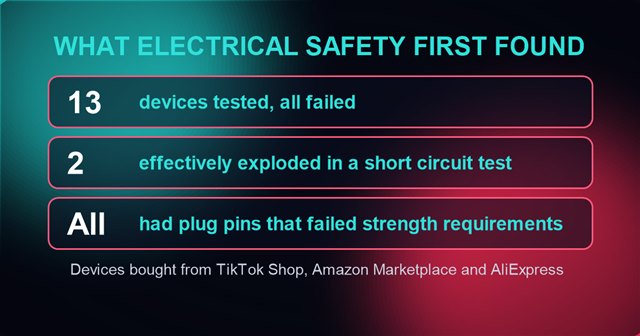
According to the charity, the plug pins on all 13 energy-saving devices failed to meet required dimensional and mechanical strength requirements, meaning they could snap under force and break inside a socket.
Inside, all of the energy-saving devices contained little more than a small circuit board that, in most cases, simply powered an LED on the front. Some appeared to contain a capacitor or filter, but closer inspection showed these were not connected to the circuit. The charity described them as “plastic boxes with nothing inside.”
Safety protection was missing or inadequate. A number of devices had no fuse or other suitable protection, while others had a glass fuse in the mains circuit, which does not meet safety requirements. Every device was also tested in an external specialist laboratory, where, the charity says, none met the required standards.
In a short circuit test, two of the energy-saving devices effectively exploded. One “exploded violently, hurling fragments of hot, glowing metal into the air,” according to the charity. A fault could spark a fire in seconds, the charity said, particularly near curtains, furniture or other flammable materials.
Why These Products Keep Coming Back
The charity points out the problem with energy-saving devices is not new. In 2022, four “energy-saving devices” were recalled for the same serious risks, and four years later near-identical devices were still on sale online.
Giuseppe Capanna, a product safety engineer at Electrical Safety First, said: “Unscrupulous third-party sellers on online marketplaces are exploiting the financial pressures facing households, promoting bogus products that prey on people’s understandable desire to save money on their energy bills.”
The timing matters for the sales pitch. The coverage notes energy bills in the UK were set to hit a three-year high, with the price cap rising 4% on October 1. A device that promises to cut a bill is easiest to sell when bills are rising. The point of the report is that the promise was not true.
Not the first warning
The coverage says previous investigations by the same charity found other dangerous products on sale online, such as travel adapters, which the coverage cites as showing this is “not a one-off issue” despite platforms describing customer safety as a priority. Taken together with the 2022 recall of four similar energy-saving devices, the pattern the charity describes is one of products being removed after a warning and then reappearing in near-identical form.
What TikTok, Amazon and AliExpress Said
Each marketplace named in the report responded, according to the coverage.
TikTok
TikTok said the products flagged in the investigation have been removed from TikTok Shop and that it notified buyers with safety guidance. It added that it has a Product Safety and Recall Policy covering concerns flagged by users and regulatory government bodies, and that it frequently engages with organizations such as the “Office of Product Safety.”
AliExpress
An AliExpress spokesperson said product safety is “our top priority,” that it removed the five listings Electrical Safety First identified, and that it is contacting affected customers to start a recall. It said it is also “reviewing the broader category for enhanced controls.”
Amazon
Amazon said it removed the products and does not allow the sale of such items under its Seller Guidelines.
The Bigger Question: Marketplace Responsibility
Capanna argued that platforms need to do more: “Online marketplaces must take greater responsibility for the products they allow to be sold on their platforms.” He also said “claims of commitment to consumer safety ring hollow while hazardous products remain available at the click of a button.”
The coverage adds the legal backdrop. Online marketplaces are currently not legally recognized as part of the traditional supply chain and have no direct responsibility for ensuring that products sold on their platforms are safe. The UK government is considering new legal duties requiring marketplaces to prevent unsafe products from being listed, backed by enforcement powers and penalties.
That is a UK discussion, and the report is about UK shopping. It is still a useful picture of how third-party selling works on any marketplace, including the retail brands now opening on TikTok Shop, where the seller is a known retailer rather than an anonymous third party.
What Shoppers Can Take From It
The report does not contain a shopping checklist, but its findings point to a few sensible habits.
- Be skeptical of savings claims on a plug. The charity found these devices could not deliver the savings they promised.
- Read the reviews for safety words. Buyers in this case had already warned of a “genuine fire hazard.”
- Treat near-identical listings as a warning sign. Similar devices were recalled in 2022 and were back four years later.
- If you bought one, follow the safety guidance from the seller or marketplace, and consider asking for a refund. TikTok said it notified buyers.
These are takeaways from the charity’s findings, not official safety instructions.
Frequently Asked Questions
Did all energy-saving devices fail the safety tests?
All 13 energy-saving devices tested by Electrical Safety First failed. The report does not claim to cover every energy-saving device on sale.
Were the devices sold on TikTok Shop?
The energy-saving devices were bought from online marketplaces including TikTok Shop, Amazon Marketplace and AliExpress. TikTok says the flagged products have been removed from TikTok Shop.
Do energy-saving plugs really save electricity?
According to Electrical Safety First, these devices could not deliver the savings they claimed, and because they use electricity themselves, they would cost users more to run.
What did TikTok do about the devices?
TikTok said it removed the products flagged in the investigation from TikTok Shop and notified buyers with safety guidance.
Sources: SWNS coverage of Electrical Safety First’s investigation, via Yahoo.