TikTok Child Safety: Three Separate Tracks in September 2026
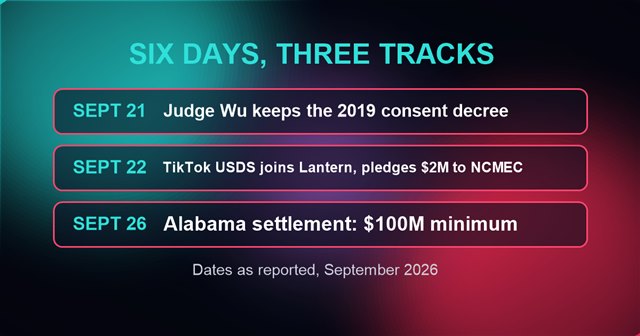
TikTok child safety made news from three different directions in six days. On September 21, a federal judge kept a 2019 child-privacy order in place. On September 22, TikTok’s US company joined an industry program for sharing child-safety signals and pledged $2 million to a national reporting hotline. On September 26, TikTok settled Alabama’s lawsuit over teen safety.
Each TikTok child safety story has been reported on its own. Put side by side, they show three very different kinds of TikTok child safety mechanism: a court order, a voluntary program and a negotiated settlement. This piece lays out what each one actually is, who it binds, and what the public record does not yet say.
What to know:
- September 21: Judge George Wu formally adopted his ruling refusing to end the 2019 Musical.ly consent decree, which keeps TikTok under reporting duties through 2029.
- September 22: TikTok USDS Joint Venture joined Lantern, a cross-platform child-safety program run by the Tech Coalition, and committed $2 million to modernizing the National Center for Missing and Exploited Children’s CyberTipline.
- September 26: TikTok settled with Alabama for at least $100 million and agreed to a list of teen-account changes in that state.
- The difference: a court order and a settlement carry legal force. Lantern is a participation program, and the announcements describe sharing and funding, not penalties.
In this article
Track One: The Consent Decree Stays
The oldest piece of TikTok child safety oversight is also the one with the most legal force. In 2019, Musical.ly, the lip-sync app ByteDance acquired and folded into TikTok, agreed to a permanent injunction with the FTC over children’s privacy violations. That order still governs how the app handles data from users under 13.
In August 2026, the Justice Department announced a $400 million settlement of its separate COPPA lawsuit against TikTok and ByteDance. Of that, $300 million was due immediately and $100 million was contingent on a court vacating the 2019 consent decree. This site covered the deal in its original breakdown.
Judge George H. Wu was not persuaded to vacate it. In his tentative ruling, he wrote that the government “has not shown that the changes in TikTok’s ownership, the changes to the platform’s compliance measures, or the recent settlement warrant termination” of the order. On September 21, he formally adopted that position, which keeps TikTok’s reporting duties in place through 2029. The full story is in this site’s consent decree ruling piece.
This TikTok child safety track was not a company decision. A court decided it, over the government’s request to end the order.
Track Two: Lantern and the $2 Million Pledge
The next day, TikTok’s US unit, known as TikTok USDS Joint Venture, announced it was joining Lantern. TechCrunch reported that Lantern is a cross-platform child-safety program launched by the Tech Coalition in 2023. It helps companies securely share signals of harmful behavior and content so they can identify bad actors who move from one platform to another.
Members include Google, X, Snap, Twitch, Anthropic, Meta, Discord, Microsoft, Apple, Roblox and Reddit, among others. Through 2025, Lantern says participating companies have shared over 2 million signals of potentially violating behavior.
Lantern’s director, Marc Leone, said in a statement: “Cross-platform collaboration is essential to identifying and disrupting child sexual exploitation and abuse, and TikTok USDS JV’s participation will help strengthen coordinated enforcement across the wider tech ecosystem.” TechCrunch added that joining makes sense because most of TikTok’s competitors already take part.
The $2 million for NCMEC’s CyberTipline
The same TikTok child safety announcement included money. TikTok’s US venture committed $2 million to the National Center for Missing and Exploited Children’s effort to modernize its CyberTipline, the channel through which US companies report child sexual abuse material. TechCrunch notes that US-based companies are legally required to report to it, and that TikTok’s US venture has been doing so.
The $2 million sits inside a larger project. The NCMEC effort is expected to take three years and cost $10 million, with AWS, Microsoft and Palantir also contributing resources. In the press release TikTok quoted by TechCrunch, the company said: “This investment will help NCMEC deploy advanced search, automation, and analysis tools to detect harm sooner, cut manual processing times in half, and accelerate actionable reports to law enforcement when a child’s safety is on the line.”
The Next Web’s coverage adds context on the company itself: TikTok USDS Joint Venture formed in January 2026 and is 50.1% American-owned, with ByteDance at 19.9% and Oracle, Silver Lake and MGX at 15% each. TechCrunch put the timing in perspective, describing the announcement as coming eight months after the joint venture was established.
Track Three: The Alabama Settlement
The third TikTok child safety track came on September 26, when TikTok settled Alabama’s 2025 lawsuit, which accused the company of designing its platform with addictive features and misleading the public about its safety. According to the Alabama Attorney General’s press release, the state is guaranteed at least $100 million within 45 days, with a ceiling of $300 million. Up to $183.8 million of that ceiling depends on whether other states reach their own qualifying settlements, per CBS News.
The deal came three days before jury selection was set to begin in what would have been the first state jury trial over TikTok’s algorithm and addiction claims. This site’s Alabama settlement breakdown has the full terms.
For Alabama teens, this TikTok child safety settlement requires specific changes, including a two-hour daily limit with parental controls able to tighten it, “productive pause” prompts at 15, 60 and 90 minutes, a midnight-to-6 a.m. access restriction, a non-personalized feed option, private-by-default accounts, stronger age verification and a ban on cosmetic-procedure filters. These apply to accounts in Alabama.
A TikTok USDS Joint Venture spokesperson said the agreement “builds on our commitment and core objective to continually enhance our robust safety tools to protect teens,” according to CBS News and WBHM.
How the TikTok Child Safety Tracks Differ
The three TikTok child safety tracks sound alike in headlines. In mechanics they are not. Here is each one on four plain questions.
The consent decree
Who set it up: a federal court, from a 2019 FTC case. What it covers: how children’s data under 13 is handled, with reporting duties through 2029. What it costs: compliance obligations, plus a $100 million contingency in the 2026 federal settlement that is now in doubt. Who can enforce it: the court.
Lantern and the NCMEC pledge
Who set it up: the Tech Coalition, with TikTok choosing to join. What it covers: sharing signals about child sexual exploitation and abuse across platforms, plus funding for the CyberTipline upgrade. What it costs: $2 million, as announced. Who can enforce it: the announcements do not describe an enforcement mechanism or penalties.
The Alabama settlement
Who set it up: Alabama’s attorney general, through a lawsuit filed in 2025. What it covers: teen-account design, in Alabama. What it costs: at least $100 million, up to $300 million. Who can enforce it: the settlement terms are between the state and the company.
One more comparison is useful. Meta settled with a coalition of 52 attorneys general on August 26, according to the Alabama Attorney General’s release on that deal, covering similar claims about Facebook and Instagram. Alabama’s TikTok deal is a one-state agreement, and the ceiling’s link to other states is what keeps the wider picture open.
What the Public Record Does Not Say
Several TikTok child safety questions are open as of October 3, 2026. None of the three tracks answers whether the changes work, only that they were announced or ordered.
- The Alabama payment: the guaranteed $100 million is due within 45 days of the September 26 announcement, which puts the deadline around November 10.
- Other states: the extra $183.8 million in Alabama’s ceiling depends on other states’ settlements, and this site has not seen one announced for TikTok.
- The $100 million contingency: with the consent decree staying in place, the contingent part of the federal settlement remains in jeopardy.
- Lantern results: this site found no figure for TikTok’s own signal-sharing, and the 2 million number is for all members through 2025.
- Outside Alabama: the settlement’s teen-account changes are described for Alabama accounts. This site has not seen a statement about extending them to other states.
This site will keep tracking TikTok child safety developments as they are filed or announced. For the broader week around these three stories, see the Sept 21-27 news roundup.
Frequently Asked Questions
What is Lantern?
Lantern is a cross-platform child-safety program launched by the Tech Coalition in 2023. Member companies securely share signals of harmful behavior and content so they can identify bad actors who move across platforms.
When did TikTok join Lantern?
TikTok’s US unit, TikTok USDS Joint Venture, announced it was joining on September 22, 2026, alongside a $2 million commitment to NCMEC’s CyberTipline modernization.
Does the Alabama settlement apply to every TikTok user?
No. The teen-account changes are described for accounts in Alabama. The settlement is between the state and TikTok.
Is the 2019 consent decree still in force?
Yes. Judge Wu formally adopted his ruling on September 21, 2026, refusing to vacate it, which keeps TikTok’s reporting duties in place through 2029.
Where do the TikTok child safety cases stand now?
As of October 3, 2026, the 2019 consent decree remains in force, the Alabama settlement’s guaranteed $100 million is due within 45 days of September 26, and TikTok’s US unit has joined Lantern. Whether other states settle, and whether the federal contingency is resolved, is not yet known.
Sources: TechCrunch, The Next Web, Alabama Attorney General, CBS News, WBHM, Justice Department.