TikTok Teen Ban in Australia Is Failing, 2026 Data Shows
TikTok logo/trademark referenced in this article’s hero and in-article images is property of its respective owner, used here for editorial identification purposes.
Australia banned social media for anyone under 16 in December 2025 and called it the toughest law of its kind anywhere in the world. Eight months later, the TikTok teen ban meant to back that promise up is barely functioning. New data shows almost as many young teens using TikTok today as before the law existed, and the government hasn’t fined a single platform for it.
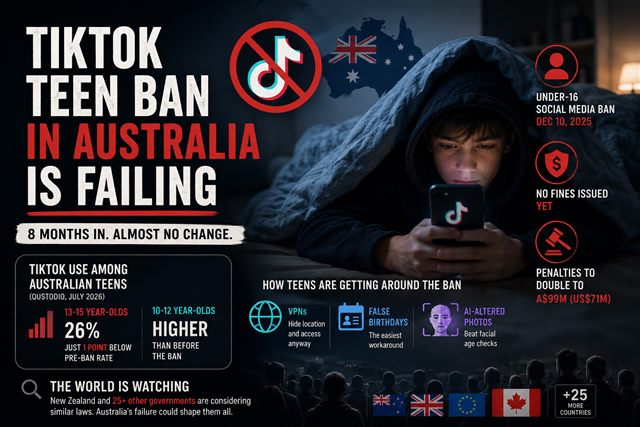
- The law: Australia’s under-16 social media ban took effect December 10, 2025, covering TikTok, Instagram, YouTube, Snapchat, Facebook, and several other platforms
- The new data: Qustodio’s July 2026 numbers put TikTok use among 13-15 year-olds at 26%, just one percentage point below the pre-ban rate. Use among 10-12 year-olds is now higher than before the ban
- How they’re doing it: VPNs to fake a location, false birthdates, and AI-altered photos designed to defeat facial age-estimation checks
- Enforcement so far: zero platforms fined, though Australia has pledged to roughly double the maximum penalty
- Why it matters beyond Australia: New Zealand and more than two dozen other governments are watching this exact experiment before deciding whether to copy it
In this article
What the TikTok teen ban actually requires
The law that created Australia’s TikTok teen ban doesn’t ban teenagers directly. It puts the obligation on the platforms: TikTok, Instagram, YouTube, Snapchat, Facebook, and a handful of others are required to take “reasonable steps” to keep under-16 accounts off their services or face fines. Prime Minister Anthony Albanese called the rollout “a proud day” when it took effect on December 10, 2025, framing it as a mental-health protection measure other countries would eventually follow.
“Reasonable steps” was always the soft part of the law. It doesn’t specify a particular verification method, which left platforms to build their own age-estimation systems largely on their own timeline. Original penalties for noncompliance topped out around A$50 million per breach. After eight months of the TikTok teen ban producing almost no visible effect, the government has pledged to roughly double that maximum, to about A$99 million (US$71 million), though the increase hadn’t been formally enacted as of this month.
Eight months in, the numbers don’t lie
Australia’s own eSafety Commissioner ran the first real check on the TikTok teen ban’s effectiveness, publishing a three-month evaluation on July 31, 2026 that tracked more than 4,100 children and families. It found that 81.5% of under-16s were still using at least one social media platform, down only slightly from 85.9% before the law took effect, a four-point dip that falls well short of the platforms disappearing from teenagers’ lives, which was the entire premise of the ban. The more telling number sits underneath that headline figure: formal account ownership among under-16s dropped from 52.4% to 42.1% over the same three months, meaning most of the kids who lost or hid an official account simply kept using the platforms anyway, logged in on a parent’s device, a sibling’s account, or one they’d quietly reopened.
The picture at eight months is worse for the law’s supporters, not better. Qustodio, which builds parental-control software and pulled data from roughly 19,000 Australian families with it installed, found that 26% of 13-15 year-olds were still using TikTok as of July 2026, just one percentage point below where usage sat before the ban. Among 10-12 year-olds, a group the law was specifically designed to keep off the platform entirely, TikTok usage is now higher than it was pre-ban. WhatsApp, which isn’t covered by the restrictions, saw usage among 13-15 year-olds jump from 27% to 36% over the same period, evidence that some of the traffic simply moved rather than disappeared.
“Kids want access because they want to be connected just like the rest of us,” Qustodio’s Yasmin London said of the findings, a plain explanation for why a law built on account deactivation hasn’t translated into actual teenagers logging off.
How teens are actually getting around the TikTok teen ban
None of this requires much technical skill. Reporting from around the ban’s launch described Australian teenagers openly trading tips on how to fool the facial age-estimation tools platforms use, including a trick as simple as making a double chin to read as older to the scanner. VPNs that mask an account’s location so it doesn’t register as Australian are widely available and, per Australia’s own eSafety regulator, not guaranteed to be blocked even under compliant systems. Lying about a birthdate at signup remains the single most common workaround, since most platforms still don’t cross-check it against anything.
Some workarounds have gotten more sophisticated. NBC News reported teenagers using AI image generators to produce an older-looking version of their own face specifically to pass facial age checks, essentially fighting the platforms’ AI-based verification with AI of their own. Meta, one of the companies the TikTok teen ban’s underlying law applies to, has acknowledged that the rules may simply be pushing younger users toward corners of the internet with even less oversight than the platforms they left, telling regulators there was “little interest in compliance” among the age group the law targets.
Why enforcement has stalled completely
Eight months in, Australia hasn’t fined a single platform under the TikTok teen ban. Part of that is the vagueness of “reasonable steps” as a legal standard: proving a platform failed to take reasonable action is a much higher bar than proving underage accounts still exist, and regulators appear to be building enforcement cases rather than issuing fines on the current usage numbers alone. Part of it is timing. Australia’s eSafety Commissioner has enhanced enforcement powers coming alongside the pledged fine increase, but neither had formally taken effect as of this month, meaning the law has spent its entire life so far without its sharpest teeth.
Albanese has stuck to the position that early friction was expected, saying the rollout “was always going to be bumpy” rather than treating the eight-month numbers as evidence the approach itself needs rethinking. Whether doubling the maximum fine actually changes platform behavior, as opposed to just raising the theoretical ceiling on a penalty nobody has been charged yet, is the open question hanging over the whole law.
Why this TikTok teen ban is being watched well beyond Australia
New Zealand announced plans this week to pursue a similar under-16 restriction, and more than two dozen other governments have implemented or are actively drafting comparable rules, according to reporting on the policy’s spread. Nearly all of them are waiting to see whether Australia’s numbers improve before finalizing their own approach, which makes the current data more than a local story. A law this high-profile producing barely a one-point dip in actual usage is exactly the kind of result that either kills the momentum behind copycat legislation elsewhere or forces the next country in line to design something with real enforcement teeth from day one.
The UK isn’t waiting to find out. Britain’s Social Media (Minimum Age) Act received royal assent in June 2026, banning under-16s from platforms including TikTok, Snapchat, and YouTube and requiring age verification across the board, with multimillion-dollar fines for platforms that fail to take “reasonable steps” to keep younger users off, nearly identical language to the standard Australia’s TikTok teen ban already uses and is already struggling to enforce. France has gone further still: the French Parliament has cleared the way for President Macron’s push to bar under-15s from TikTok and Instagram by September 2026, which would make France the first EU country to legislate a ban rather than just study one. Both laws are essentially betting they can avoid Australia’s enforcement gap by writing tighter rules from the start. Whether “reasonable steps” turns out any less vague coming from London or Paris than it has from Canberra is the real test neither government has faced yet.
It’s a different fight from the one that’s played out in the US, where the debate has centered on banning TikTok outright over national-security concerns rather than restricting it by age. Our earlier coverage of the TikTok ban rollercoaster in the US covered that separate fight in detail. But American lawmakers pushing their own under-16 or age-verification proposals are watching the same Australian data everyone else is, and a TikTok teen ban that can’t get workaround rates below the high 70s isn’t the kind of case study that makes stricter age laws an easier sell.
Quick answers
Is Australia’s TikTok teen ban actually working? Not by its own goal. Eight months in, TikTok use among 13-15 year-olds sits just one percentage point below pre-ban levels, and use among 10-12 year-olds is now higher than before the law.
How are teens getting around the TikTok teen ban? Mainly VPNs to mask their location, false birthdates at signup, and in some documented cases AI-generated photos designed to defeat facial age-estimation checks.
Has TikTok or any other platform been fined yet? No. Zero platforms have been fined as of this month, though Australia has pledged to roughly double the maximum penalty to about A$99 million (US$71 million).
Is this the same as the US TikTok ban fight? No. Australia’s law restricts TikTok and other platforms by user age; the US debate has focused on banning TikTok nationally over national-security concerns. They’re separate fights, though US lawmakers pushing age-based restrictions are watching Australia’s enforcement numbers closely.
Are other countries copying Australia’s approach? New Zealand announced plans this week to pursue a similar law, and more than two dozen other governments have implemented or are drafting comparable under-16 restrictions.
Usage data referenced above draws on the eSafety Commissioner’s three-month evaluation report and Qustodio’s July 2026 family-device data. Additional detail on enforcement and international response via NBC News.