TikTok Algorithm 2026: Critical Facts vs. Hype
Type “TikTok algorithm 2026” into a search bar and nearly every result is a marketing agency’s guide, most of them citing each other instead of TikTok. The company’s own account of how its recommendation system works is shorter, older, and considerably more limited than the guides suggest. This piece separates what TikTok has actually confirmed, in its own published words, from what the wider SEO industry has inferred, and looks at where TikTok’s search function, a genuinely different system from the For You feed, fits into the whole picture.
- TikTok’s core explainer is old: the company’s only detailed public document on ranking, “How TikTok recommends videos,” dates to June 2020 and has never been publicly revised, even as new discovery tools launched around it
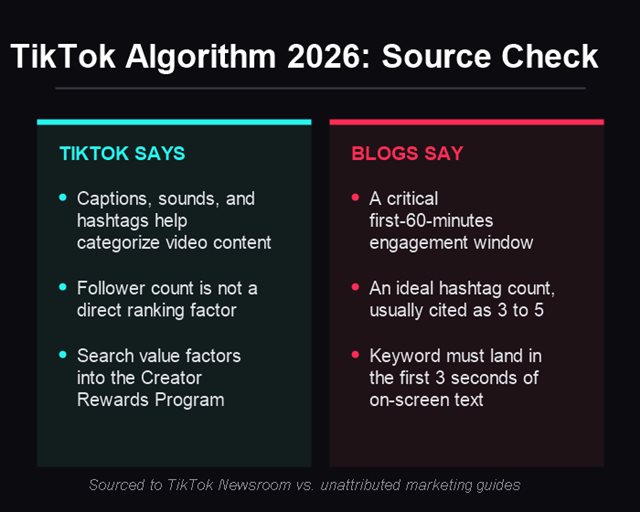
- What’s confirmed: captions, sounds, and hashtags help categorize a video; follower count and past video performance are explicitly not direct ranking factors
- Search runs on different signals: TikTok’s own Creator Search Insights tool exists specifically to show creators what people are typing into the search bar, a separate discovery surface from the For You feed
- What’s not confirmed: a specific “first 60 minutes” engagement window, an exact ideal hashtag count, and a precise on-screen-text keyword timing all come from marketing blogs, not from TikTok
- Independent evidence exists too: a 2025 Washington Post data investigation mapped 121,000 real videos and found patterns that line up with TikTok’s own claims, without relying on TikTok’s word for it
In this article
What TikTok Itself Confirms About the Algorithm
TikTok’s canonical statement on how the TikTok algorithm 2026 actually ranks video is a Newsroom post titled “How TikTok recommends videos #ForYou.” It was published June 18, 2020, and as of September 2026 it has not been publicly replaced or revised, even though the platform has shipped several new discovery products since. It’s still the document nearly every agency guide traces back to, whether they cite it or not.
TikTok describes three groups of signals that feed the For You feed. The first is user interactions: “videos you like or share, accounts you follow, comments you post, and content you create.” The second is video information: “details like captions, sounds, and hashtags.” The third is device and account settings, which the company says receives comparatively lower weight, “language preference, country setting, and device type.”
New accounts aren’t left to figure it out alone, either. TikTok says it invites new users to select categories of interest, “like pets or travel, to help tailor recommendations to their preferences,” before it has any behavioral data to work with. From there, the company’s own description is that recommendations sharpen with use: “over time, your For You feed should increasingly be able to surface recommendations that are relevant to your interests.”
Notice what’s missing from TikTok’s own list. No specific numeric weighting between the three signal groups. No stated time window for how quickly a video is judged. No confirmed formula at all, just three labeled inputs and a general statement that heavier engagement, like finishing a longer video, counts for more than a lighter one. Everything more specific than that is somebody else filling in the gaps.
What TikTok Says Does Not Affect the TikTok Algorithm 2026
The same Newsroom explainer is unusually direct about what doesn’t count. TikTok states plainly that “neither follower count nor whether the account has had previous high-performing videos are direct factors” in how a video gets recommended. That’s a real, specific claim, not a vague reassurance, and it’s the single most-cited line from the whole document across the SEO industry.
The practical version of that statement: a brand-new account with zero followers is not automatically capped in how far a single video can travel, and an account that had a viral hit last month isn’t guaranteed the same reach on its next upload. Each video is evaluated on its own signals within the TikTok algorithm 2026, at least according to what TikTok itself has published.
TikTok’s explainer also describes a separate layer that isn’t really “ranking” at all, it’s eligibility. The company says some content is excluded from recommendations outright: duplicate content, spam, and material still under active moderation review. That’s a filter applied before a video is even in the running, distinct from the weighting that happens once a video clears it.
TikTok Search: A Different System From the For You Feed
The 2020 Newsroom explainer covers For You recommendations, not the Search tab, and TikTok has never published an equivalent deep-dive on how search ranking specifically works. What does exist is a real, concrete product: Creator Search Insights, which TikTok’s Newsroom announced on March 13, 2024, and which is still live as of September 2026.
TikTok describes it as “a new tool, available in select regions, that gives creators insight into topics people are searching for on TikTok.” Rather than guessing what people type into the search bar, creators can look it up directly, sorted either by broad category (tourism, sports, science) or by a “For You” view scoped to their own content type.
The tool’s most useful feature for anyone trying to reason about the TikTok algorithm 2026 is what TikTok calls a content gap: topics that are “searched for often, but aren’t featured in a large number of videos on TikTok.” That’s TikTok directly telling creators where search demand is outrunning supply, a genuinely different signal from anything in the For You explainer.
TikTok goes further than just surfacing the data. The company states that “search value will also factor into the Creator Rewards Program,” meaning content tied to in-demand search topics can carry a financial incentive on top of any organic reach it earns. That’s the clearest evidence TikTok has published that it treats search as a distinct, deliberately built discovery surface, not a side effect of the same ranking system that runs the For You feed.
Search on TikTok also works mechanically differently from browsing the For You feed. According to TikTok’s own support documentation, typing a query into the Search tab surfaces the most relevant results in a “Top” tab by default, with a separate Filters option to narrow by category, and a screenshot-based visual search that matches content by image rather than text. None of that overlaps with how a video lands in someone’s unprompted For You feed in the first place.
Where Marketing Blogs Go Beyond TikTok’s Own Words
This is where most “TikTok algorithm 2026” guides actually come from, and it’s worth being specific about the gap rather than dismissing all of it. Three claims show up across nearly every agency guide currently ranking for the topic, and none of them trace back to anything TikTok has published.
The “first 60 minutes” window. Guides from agencies describe a critical early-engagement period, often specifically 30 to 60 minutes, after which the algorithm has effectively decided a video’s fate. It’s a real, widely repeated claim. It is not, however, anywhere in TikTok’s own documentation. It reads as an inference from watching how quickly some videos accelerate and others stall, not a rule TikTok has confirmed exists as a hard cutoff.
The “ideal” hashtag count. Sprout Social’s own 2026 guide, along with several similar agency posts, recommends three to five hashtags per post as the sweet spot. TikTok’s Newsroom explainer confirms hashtags are used as a categorization signal, full stop, with no stated ideal quantity. The specific number is an agency’s operational advice, not a platform-confirmed rule.
Keyword placement in the first three seconds. Multiple SEO-focused guides advise putting a target keyword in the first sentence of the caption and the first three seconds of on-screen text, so “the algorithm can match your videos to what users are searching for.” The underlying mechanic, captions and on-screen text feeding categorization, does trace back to TikTok’s confirmed signal list. The specific three-second window does not.
A fourth claim worth flagging separately: several 2026 guides argue that a focused, single-niche account builds a stronger “category association” over time than an account that posts across unrelated topics, and that switching topics forces the algorithm to effectively restart its read on the account. That idea is a reasonable extension of TikTok’s confirmed use of posting history as a signal, but the specific “restart” penalty is agency inference, not something TikTok has stated as a rule.
What Independent Research Has Found
There’s a third category of evidence beyond TikTok’s own statements and the marketing industry’s advice: independent research that doesn’t depend on TikTok’s word for it at all. The Washington Post ran one of the more rigorous efforts in 2025, building its own model of how TikTok’s recommendations actually cluster content by analyzing 121,000 real videos pulled from roughly 1,100 users’ actual watch histories.
The Post’s team mapped which videos tend to reach the same audiences and plotted the results as a two-dimensional map of topic clusters. Broad categories like comedy showed up as large, sprawling regions because they appeal across many different viewers. Narrower interests, cats among them, formed small, comparatively isolated pockets.
Distance on that map reflected how often the same viewers crossed between topics. Moving from comedy content to family content was common. Moving from cat content to political content was rare enough to register as its own boundary. Certain intensely dedicated fandoms, cited in the analysis as an example, formed islands that were largely disconnected from the rest of the platform’s content graph.
None of that came from TikTok. It’s independent researchers reverse-engineering real behavior from real data, and it lines up with TikTok’s own claim that category and topic signals genuinely shape what gets recommended to whom, without requiring anyone to just take the company’s word for it. That kind of outside verification is rare in this space, and it’s a meaningfully different category of evidence than either an official statement or an agency’s operational advice.
Is TikTok Really Becoming a Search Engine?
The idea that TikTok is displacing Google traces back to one specific moment: Google senior vice president Prabhakar Raghavan, speaking at Fortune’s Brainstorm Tech conference in July 2022, said, “In our studies, something like almost 40% of young people, when they’re looking for a place for lunch, they don’t go to Google Maps or Search. They go to TikTok or Instagram.”
That line generated headlines across the industry, including framing that TikTok had become “the new search engine” for a generation. The actual claim was narrower than the coverage suggested. Google later confirmed to TechCrunch that Raghavan was describing an internal, non-public survey of U.S. users ages 18 to 24, specifically about searching for a place to eat lunch, not general search behavior across every kind of query.
That context matters for anyone trying to size up the TikTok algorithm 2026 as a genuine search competitor. A narrow, self-reported statistic about restaurant searches from 2022 isn’t the same as proof that TikTok has broadly replaced Google for young users. What’s more solid is the product evidence: Creator Search Insights, the content-gap feature, and search value tied to actual creator payouts through the Rewards Program are TikTok visibly investing in search as its own real discovery surface, regardless of how the original statistic got framed by everyone else.
What the TikTok Algorithm 2026 Means for Getting Found
Strip out the unconfirmed specifics and what’s left is still genuinely useful, because it’s grounded in what TikTok has actually said rather than a guessed formula. A few things follow directly from the confirmed mechanics above.
- Write real, specific captions and on-screen text describing what the video is actually about. This isn’t a trick, it’s the literal categorization signal TikTok confirmed it uses.
- Check Creator Search Insights directly for real, in-demand search terms in a given niche instead of guessing keywords from a blog post’s example list.
- Don’t assume a low follower count caps a video’s reach, or that one underperforming post permanently damages an account. TikTok’s own statement says neither is a direct factor.
- Treat any claim with a specific number attached, an exact minute count, an exact hashtag total, as an agency’s observed pattern rather than a platform rule, and expect it to shift as TikTok updates its systems.
As of September 2026, TikTok has not published a revised version of its 2020 recommendation explainer, even as products like Creator Search Insights and Manage Topics, a 2024 feature that lets users slide preference controls for broad topics like sports or travel directly in their settings, have visibly expanded how discovery actually works. Anything in this piece not directly sourced to TikTok should be read as a snapshot of 2026 industry consensus, not a fixed, permanent rule, because the underlying system keeps changing even when the public documentation doesn’t.
For a look at how TikTok has changed what actually gets rewarded on the ranking side of things, our coverage of TikTok’s rage-bait content moderation shift covers a real, confirmed case where the platform moved away from rewarding engagement for its own sake. And for another example of TikTok publishing specifics about a discovery feature rather than leaving it to outside guesswork, see our breakdown of TikTok’s 2026 comment tools.
Quick Answers
Does TikTok confirm a “first 60 minutes” ranking window? No. TikTok has never published a specific early-engagement time window in its own documentation. It’s a claim that comes from marketing agencies describing observed patterns, not from TikTok itself.
Does follower count affect how far a TikTok video reaches? TikTok’s own Newsroom explainer states directly that follower count is not a direct ranking factor, and neither is whether an account has had previous high-performing videos.
What is Creator Search Insights? A TikTok tool launched in March 2024 that shows creators real search terms people are typing into TikTok’s search bar, including “content gap” topics with high search interest but little existing video coverage.
Is TikTok actually replacing Google for search? Not by confirmed, broad evidence. The widely cited “almost 40% of young people” statistic came from a narrow, non-public 2022 Google survey specifically about restaurant and lunch searches, not general search behavior.
Has TikTok updated its official algorithm explainer for 2026? No public revision has been made to TikTok’s original “How TikTok recommends videos” page since its June 2020 publication, even though newer discovery products have launched around it since.
Primary sourcing for this piece: TikTok Newsroom’s “How TikTok recommends videos #ForYou” and “Get inspired with Creator Search Insights”. Additional reporting drawn from The Washington Post’s 2025 video-mapping investigation and TechCrunch’s reporting on the 2022 Google search statistic.