
TikTok Filming Tips: What Creator Academy Says About Lighting, Framing and Camera Moves (2026)
TikTok’s Creator Academy has three guides on how a video looks: Lighting 101, Filming 101 and Filming 102. Together the TikTok filming tips in them cover where to put a light, how to frame a shot, how to move the camera and which frame rate suits which kind of video. TikTok opens Filming 102 with the point that “great cinematography isn’t only for movies on the big screen; you can use these same techniques to take your TikTok videos to the next level.”
This guide to TikTok filming tips reports what TikTok says on three pages: Lighting 101 – Crafting content that dazzles, Filming 101: Thinking like a director and Filming 102: Creating interest through cinematography. Every tip below is credited to TikTok.
TikTok filming tips at a glance:
In this article
- Lighting: TikTok’s three-point setup uses a key light, a fill light and a backlight, with the key light placed “at a 45° angle to the side of your camera, and 45° higher than your subject’s eyeline.”
- Framing: divide the frame into thirds, or use symmetry, to place the subject on purpose.
- Camera: TikTok lists five movements (pan, tilt, dolly, zoom, tracking) and five angles, from bird’s-eye to worm’s-eye.
- Frame rates: TikTok matches 24fps to a “cinematic” look, 30fps to “soap opera,” 60fps to “sports” and 120 or 240fps to slow motion.
TikTok Filming Tips: What the Three Pages Cover
The three pages move from the plan to the light to the camera, so the TikTok filming tips follow a natural order. Filming 101 is about planning and composition. Lighting 101 is about the scene’s light. Filming 102 is about cinematography: mise-en-scene, depth, camera movement, camera angles and frame rates. TikTok’s first line in Filming 101 sets the tone: “Ready to reach red-carpet-level status with your content? It’s time to start thinking like a film director!”
Filming 102 also says the TikTok filming tips do not need expensive equipment. TikTok writes: “Ditch the complicated setup and try using a stack of books as a tripod or a phone attached to a skateboard for movement to easily make your shots look more professional.”
TikTok Filming Tips From Filming 101
The first of the TikTok filming tips in Filming 101 is a set of four ways to “level up your content easily.” TikTok’s wording:
- Sketch out a production plan. “Think about how you want your video to look and feel. Decide on specifics like lighting, transitions, and effects before you start filming to make the post-production process easier.”
- Be intentional with your aesthetic. “Consistency is key to maintaining your viewers’ attention.” TikTok’s examples: a garden-tending video kept “whimsical and airy with soft lighting and slow camera pans,” or a skateboarding trick compilation kept fast-paced “with quick transitions and upbeat music.”
- Create a visual brand to stand out. “Pick one aesthetic and stick to it!” TikTok says a recognizable style helps viewers “remember your content and keep coming back for more.”
- Pay attention to your composition. TikTok defines it as “how everything is arranged in a shot.”
Framing, the Rule of Thirds and Symmetry
TikTok defines framing as “a technique that directs a viewer’s eye to your desired area on a screen.” It says a creator can frame a shot “by positioning your subject within, or in front of, a physical structure like a door frame, window, or wall,” and that framing “can also be done with color, texture, and light.” TikTok names two guides for it, and both are among the TikTok filming tips most creators can try with a phone.
The rule of thirds
TikTok says “people’s eyes naturally go to the intersections of a frame,” and the rule of thirds “takes advantage of this by using negative space to create balance and draw viewers’ eyes to a subject.” The steps on the page:
- Divide the frame into thirds with two vertical lines, then into thirds with two horizontal lines. That leaves nine boxes.
- Place the subject in the left or right third of the frame.
- Position points of interest, “like a person’s face or the center of a flower,” at the lines.
- For a landscape, align the scene to the horizontal lines.
TikTok adds two tips: a smartphone camera app has a thirds grid overlay, and “the rule of thirds is more of a guide than a hard rule. Your shots don’t have to fit perfectly into this rule.”
Symmetry
TikTok describes symmetry as a technique “that works by creating balance on opposing sides of a frame” and says it is “a bit easier to get the hang of than the rule of thirds.” The steps:
- Divide the frame into two halves with one vertical, horizontal or diagonal line.
- Place the subject directly in the center of that line, or place two subjects on equal, opposite sides.
- With two subjects, “place them at an equal distance from the camera.”
TikTok’s tips: use the environment, “like placing a road at the center of a shot with mirroring buildings on each side,” and “crop your shots during the editing process to achieve symmetry if you missed the chance while filming.”
TikTok Filming Tips for Lighting
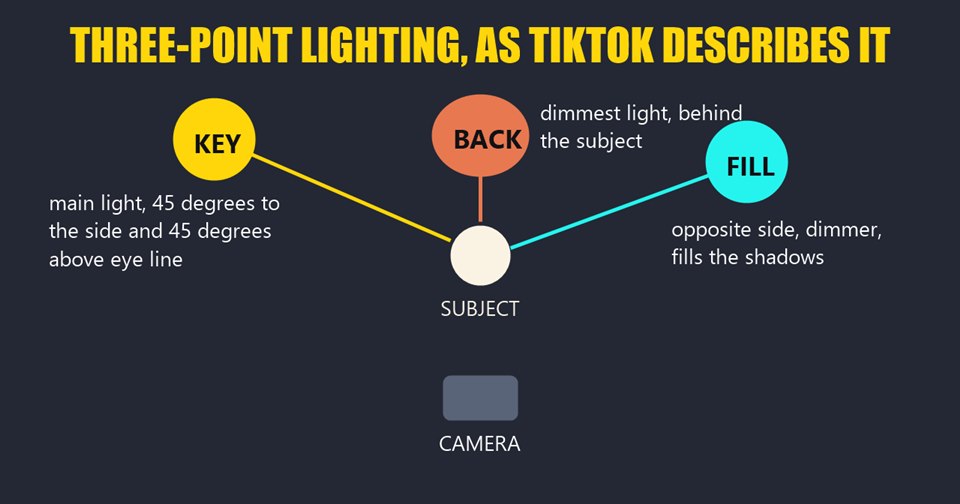
Among the TikTok filming tips on light, Lighting 101 opens with “you can’t say camera and action without first shouting lights! Lighting can make or break your TikTok, so it’s important to get it right.” It presents the three-point technique as an easy way to “add that wow factor.” TikTok describes the three lights:
- Key light. “The main source of artificial light in your scene.” It “shines on your subject to add depth and focus” and sits “at a 45° angle to the side of your camera, and 45° higher than your subject’s eyeline.”
- Fill light. “Second to the key light,” placed “on the opposite side of the key light to fill in the shadows created by the key light.” TikTok says it “is dimmer than the key light and doesn’t create its own shadows.”
- Backlight. “The dimmest light in the scene,” placed “at an angle behind the subject to create separation from the background.” TikTok says backlights “help add more depth and color to your scene.”
Soft, Hard and Rembrandt Light
After the basic setup, Lighting 101 lists more TikTok filming tips in the form of styles to experiment with. TikTok pairs each with the kind of video it has in mind:
- Soft lighting “comes from a large, balanced source and helps make the overall lighting in your scene look smoother.” TikTok’s examples are “your favorite latte recipe” or “your cozy morning routine,” to “come across as warm and friendly.”
- Hard lighting “comes from a smaller, focused source and can add drama and tension to your scene by creating defined shadows.” TikTok suggests it for “your edgy outfit of the day or your vibrant cocktail recipe.”
- Angles. After mastering three-point lighting, TikTok says to “play around with the angles of your lights for different effects,” such as moving the key light higher “for an overall brighter scene while sharing your recent thrift store haul.”
- Rembrandt lighting “creates a crisp shadow across your subject’s face to showcase highlighted features.” TikTok says to place the key light 45° to the side of the subject and higher than eye level, and suggests it for “an emotional song cover or a poetry reading.”
Accessories and an artificial golden hour
For creators who want to spend a little on their TikTok filming tips, Lighting 101 lists “diffusers, reflectors, color gels, and bounce boards.” TikTok says golden hour “offers the most flattering lighting, but it can be hard to catch those few minutes after the sun rises or before the sun sets.” Its workaround: “Use diffusers paired with a big light, a reflector to add a golden shimmer, and yellow color gels to mimic natural light and create your artificial golden hour.”
TikTok Filming Tips From Filming 102
Filming 102 defines cinematography as “the art of using specific techniques during the filmmaking process to tell a story visually.” TikTok says cinematographers “play with angles, movement, light, color, and more to add complexity to scenes and keep audiences’ eyes glued to the screen.” The page organizes its TikTok filming tips around five key elements: mise-en-scene, depth, camera movements, camera angles and frame rates.
Mise-en-Scene and Depth
Mise-en-scene. TikTok says it “refers to all the things that appear in a shot that work together to help tell your story,” including “the composition, sets, props, actors, costumes, and lighting.” The page asks creators to check whether each detail helps set the mood and adds to their style.
Depth. Of the TikTok filming tips on composition, depth is one. TikTok says it “will create more visual interest and help your content feel more real to viewers,” because it gives “the illusion of a three-dimensional image.” Its examples: a flower vase in the foreground, a blurred background to put “a clear focus on your subject,” more contrast through lighting, or color “to make your subject pop.”
Camera Movements
In the TikTok filming tips on movement, TikTok says “simply moving your camera in a shot can help enhance your storytelling by making your audience feel like part of the action!” It lists five movements to try:
- Pan: “Move from one side of a scene to another.” TikTok suggests a panoramic view from the top of a hike.
- Tilt: “Move up then down or vice versa.” TikTok suggests a dance video or a dog catching a frisbee.
- Dolly in/out: “Move in/move out in one shot.” TikTok’s example is starting with a close-up of a DIY creation, then moving out to show the creator talking.
- Zoom: “Digitally punch in or out during a scene.” TikTok suggests zooming in on selfie mode to make viewers feel they are about to hear a secret.
- Tracking: “Follow a subject throughout a shot,” such as a day-in-the-life video.
Camera Angles
In the TikTok filming tips on angles, Filming 102 says they can “totally change the vibe of your shot.” For example, “if you want to show something towering above the viewer, shooting from below will accentuate that intimidating feeling.” TikTok’s five angles, with its use for each:
- Bird’s-eye view: shot from above, “great for shooting your dinner recipe.”
- High angle: between bird’s-eye and eye-level, used for a before and after of a bathroom makeover.
- Eye-level: “great for storytimes or makeup tutorials to make viewers feel like they’re just hanging out in your room with you.”
- Low angle: “add intensity to your crazy trick shots or bring some serious drama to your outfit reveal.”
- Worm’s-eye view: shot from below and “gazing up at the scene,” such as clouds passing between skyscrapers in a travel vlog.
Frame Rates
The last of the TikTok filming tips is frames per second (fps). TikTok says to “switch your camera to the recommended fps for your niche content to make it stand out” and notes that most smartphones offer different options. Its list:
- Less than 24fps: timelapse footage
- 24fps: cinematic aesthetics
- 30fps: soap opera aesthetics
- 60fps: sports aesthetics
- 120fps or 240fps: slow-motion footage
Other guides on this site that draw on TikTok’s Creator Academy, alongside these TikTok filming tips:
- TikTok Audio Tips: Mics, Soundproofing and the Clean Track Method
- TikTok Studio: What the App, Web and In-App Versions Offer
- TikTok Templates: How to Use Them and Make Your Own
- TikTok Video Ideas: The Tools TikTok Offers
- TikTok Symphony: What TikTok Says Its AI Creative Suite Does
What TikTok’s Pages Do Not Say
- The TikTok filming tips do not tie any technique to a measured gain in views, watch time or recommendations.
- Lighting 101 does not name any light brands or give prices for the accessories it lists.
- The TikTok filming tips on Filming 102 give frame rates by style but does not say which fps TikTok’s own upload or playback uses.
- The pages describe each technique in a sentence or two and do not include diagrams in the text TikTok published.
Frequently Asked Questions
What are the basic TikTok filming tips for lighting?
TikTok’s Lighting 101 recommends a three-point setup: a key light, a fill light on the opposite side and a dimmer backlight behind the subject. The key light goes at a 45° angle to the side of the camera and 45° higher than the subject’s eyeline.
What is the rule of thirds in TikTok filming tips?
TikTok says to divide the frame into nine boxes with two vertical and two horizontal lines, then place the subject in the left or right third. It calls the rule “more of a guide than a hard rule.”
Which camera movements are among the TikTok filming tips?
Filming 102 lists pan, tilt, dolly in/out, zoom and tracking.
Which frame rate do the TikTok filming tips call cinematic?
Filming 102 pairs 24fps with “cinematic aesthetics.” It lists 30fps as soap opera, 60fps as sports, and 120 or 240fps as slow motion.
Do the TikTok filming tips require expensive gear?
Filming 102 says no. It suggests “a stack of books as a tripod or a phone attached to a skateboard for movement.” Lighting 101 lists paid accessories as an option for “looking to spend a little money.”
Sources: TikTok Creator Academy: Lighting 101, Filming 101 and Filming 102 (all read October 30, 2026).