The Kinda Chic Trend: TikTok’s 2026 Reframe, Explained
The kinda chic trend has turned “chic” into a word for almost anything except what it used to mean. Instead of designer bags or red-carpet outfits, TikTok and Instagram are calling a mid-shift coffee walk “kinda chic,” or being visibly tipsy at a work party, or just being chubby in a culture obsessed with thin. It started quietly on Instagram in the spring, spent the summer building on TikTok, and by September 2026 it’s still showing up as one of the platform’s active recurring formats.
What to Know
- The kinda chic trend’s format is a caption that starts “kinda chic to…” or “feels kind of chic to…,” paired with a photo or short video showing something ordinary, not glamorous.
- Per Know Your Meme’s tracked timeline, the earliest known post is credited to Instagram user mariabegins on April 27, 2026, framing body positivity as “kinda chic.”
- Real, oEmbed-verified examples now live on TikTok specifically, not just Instagram, including a coffee-walk post from @audragembala and a work-party post from @kks.firstsip.
- Drew Barrymore’s August 3, 2026 Instagram carousel about being in her 50s, which pulled 170,000-plus likes in four days, is widely credited with pushing the kinda chic trend into the mainstream.
- Psychology Today covered the trend on August 17, 2026, and a marketing-trend roundup from September 2, 2026 still named it as one of the month’s active formats.
In this article
What Does “Kinda Chic” Actually Mean?
The kinda chic trend follows one simple template: a caption that opens with “kinda chic to…” or “feels kind of chic to…,” followed by something the poster is doing, being, or admitting that has nothing to do with money or glamour. Know Your Meme’s tracking page for the format describes it as celebrating “personal growth, peace, body positivity and healthy states of mind” instead of a traditional, expensive definition of chic.
On Instagram, the kinda chic trend usually shows up as a photo carousel. On TikTok, it’s a short video with the caption typed directly onto the screen as on-screen text, often with the person just going about whatever the caption describes. Either way, the tone sits somewhere between sincere and self-aware, a joke that’s also kind of the point.
What actually counts as “kinda chic” is deliberately wide open. The two real TikTok examples verified for this piece alone cover a work party and a coffee break, nowhere near each other on the surface, but both fit the same format because both take something small and unremarkable and say it counts.
Where the Kinda Chic Trend Started
Know Your Meme’s earliest documented post for the kinda chic trend is credited to Instagram user mariabegins, posted April 27, 2026, who used the phrase to frame body positivity as the actually-stylish choice. That original post reportedly drew around 520 likes over its first four months, a real start but not remotely viral on its own.
The kinda chic trend spent the next several months building slowly on Instagram before it broke out. Know Your Meme’s page for the format carries a “confirmed” status with more than 12,500 tracked entries as of its most recent major update on August 14, 2026, the kind of steady accumulation that points to organic spread rather than one single viral moment.
How the Kinda Chic Trend Spread to TikTok
The kinda chic trend crossed over to TikTok for real in late July 2026. TikToker @frankiehelen posted a version on July 27, 2026, calling herself a “pro-choice, pro-vaccine tradwife,” a deliberate mismatch with the usual politics associated with that label. Per Know Your Meme, her video pulled more than 40,000 views in about two weeks.
Days later, on August 2, 2026, TikToker @lifewitht00 posted a version built around body size instead, captioned “feels kind of chic to be chubby in a world obsessed with extreme skinny.” Know Your Meme credits that post with more than 192,000 likes in five days, a much faster climb than the kinda chic trend’s original Instagram post ever saw.
Two further examples verified directly for this piece, through TikTok’s own oEmbed system, show the kinda chic trend still active on the platform weeks later. TikToker @kks.firstsip posted a version captioned onscreen “kinda chic to drink a little too much liquid courage,” reframing being overly social at a work party as a personality win rather than an embarrassment.
@kks.firstsip ESPECIALLY, if it was at a work party. And everyone will tell you that I was the life of the party #kindachic #trend #fyp #foryoupage #foryou
♬ original sound – migorengmedia
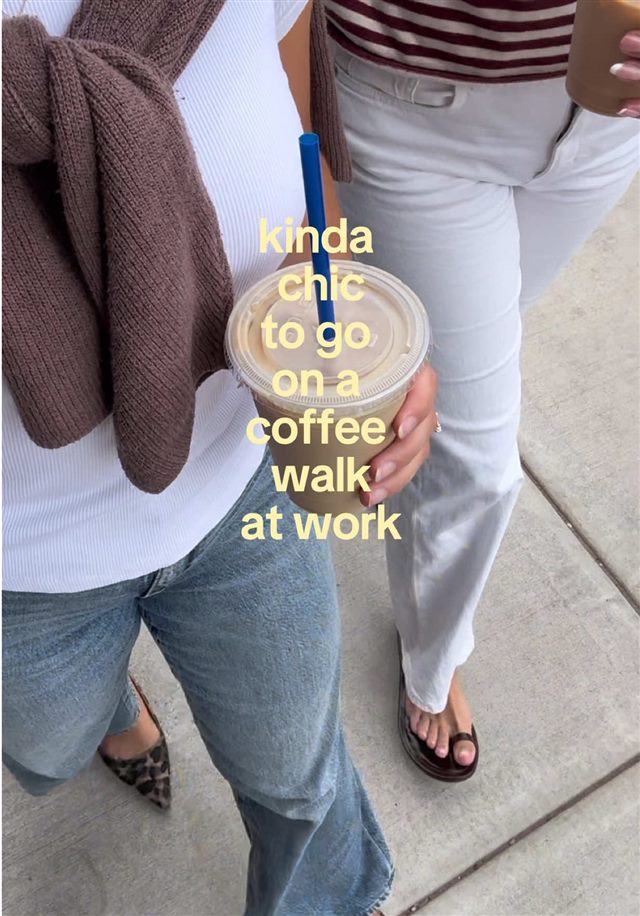
Creator Audra Gembala, posting as @audragembala, used the same kinda chic trend format for something even smaller: a mid-shift coffee run. Her on-screen caption reads “kinda chic to go on a coffee walk at work,” tagged directly with #kindachic alongside #corporategirly.
@audragembala The best mid-day pick me up!!!☕️👩🏻💻⭐️ @𝑙𝑢𝑐𝑦 𝑚𝑎𝑟𝑖𝑒 #coffeewalk #corporategirly #trend #kindachic #chic
♬ original sound – migorengmedia
That coffee-walk post is arguably the cleanest version of what the kinda chic trend is actually doing. There’s no insecurity being overcome and no big life milestone being marked, just a five-minute walk to buy iced coffee, relabeled as the stylish move rather than a break from real work.
Drew Barrymore Made It Mainstream
The kinda chic trend crossed from a niche creator format into genuine mainstream visibility on August 3, 2026, when actress Drew Barrymore posted an Instagram carousel captioned “KINDA CHIC TO BE IN YOUR 50s.” Per Know Your Meme’s tracking, that post pulled more than 170,000 likes within four days, a celebrity-scale jump from the thousands the format had been pulling up to that point.
Barrymore’s post applied the kinda chic trend to age instead of a body feature or a daily habit, treating a milestone birthday decade as the “chic” thing rather than something to downplay. That’s the same basic move as the @lifewitht00 and @frankiehelen posts described above by Know Your Meme: taking a trait that culture usually treats as a downside and reframing it as the actual win.
What a Psychologist Says Is Actually Happening
Psychology Today covered the kinda chic trend in an August 17, 2026 post by Bruce Y. Lee, M.D., M.B.A. Lee’s take treats the format as a real, if minor, cultural signal rather than just another disposable meme. He points out that the trend recognizes that most people’s actual lives are “filled with” ordinary, unglamorous moments, not the curated highlight reels social media usually rewards.
Lee frames the kinda chic trend’s self-care angle as a form of quiet permission-giving, writing that “protecting your mental, emotional, and physical health is always the cool thing to do.” His full analysis reads the trend as giving people cover to resist stereotypes around age, appearance, and how a “successful” day is supposed to look.
He doesn’t let the kinda chic trend off easy, either. Lee calls it “kinda great to give people more agency to embrace their uniqueness,” but adds it’s “kinda not so great if this is a fad that just trivializes such things,” a fair-minded caveat rather than a full endorsement.
How the Kinda Chic Trend Is Different From Wabi-Sabi and the Great Lock-In
2026 has produced more than one TikTok trend built around self-acceptance, and it’s fair to ask whether the kinda chic trend is really saying anything the others haven’t already covered. This site has recently published on two of them: the wabi-sabi trend and the Great Lock-In trend. Lined up next to each other, the three formats turn out to be doing genuinely different jobs.
Wabi-Sabi: One Physical Feature, Named Out Loud
The wabi-sabi trend is narrow by design. It’s a camera pointed at one specific physical feature, teeth gaps, scars, a crooked nose, and a caption that says the feature has “wabi-sabi” instead of being a flaw. It doesn’t extend to habits, choices, or life stages, just the body part in frame.
The Great Lock-In: A Structured Routine, Not a Caption
The Great Lock-In trend works on a completely different axis. It’s a four-month, goal-based challenge running September through December, built around 2 to 5 concrete habits, fitness targets, savings goals, screen-time limits, that a person commits to and tracks over time. There’s no single caption format, and no single video does the whole trend justice, because the Great Lock-In is a system, not a moment.
Kinda Chic: A Reframe You Can Apply to Anything
The kinda chic trend doesn’t fix on a body part like wabi-sabi, and it doesn’t ask for a tracked routine like the Great Lock-In. It’s a piece of vocabulary, one sentence structure applied to whatever the poster wants: a coffee walk, a work-party overshare, a body type, a political identity, a birthday decade. Nothing about the format restricts what qualifies as “kinda chic,” which is exactly why the same three-word phrase shows up under such different videos.
That’s the real distinction. Wabi-sabi asks what body part you’re finally showing. The Great Lock-In asks what you’re disciplined enough to stick to for four months. The kinda chic trend doesn’t ask either question, it just hands out permission to call the ordinary, unglamorous version of your life stylish, whatever that version happens to be.
Is the Kinda Chic Trend Still Going in September 2026?
Yes, based on the most current sourcing available for this piece. A trend roundup from marketing agency Pepper Agency, published September 2, 2026, names the kinda chic trend as one of the clearest themes running through that month’s TikTok and Instagram activity, describing creators using the phrase to “romanticise behaviours that wouldn’t traditionally be considered particularly glamorous, whether that’s staying home on a Saturday, repeating an outfit or generally choosing the less exciting option.”
Both TikTok videos verified directly for this piece, @kks.firstsip’s and @audragembala’s, were still live and embeddable through TikTok’s oEmbed system at the time of writing, carrying the #kindachic hashtag directly in their captions rather than an older or unrelated tag. That’s a real, current signal, not a trend being written about only in the past tense.
One honest limit is worth stating plainly. This piece could not independently verify a specific, current TikTok video from either @frankiehelen or @lifewitht00, the two named TikTok creators most credited with popularizing the kinda chic trend, since neither video’s exact URL could be confirmed through this site’s own research. Both creators’ contributions here rest on Know Your Meme’s reporting rather than a direct embed, and that distinction is intentional rather than an oversight.
Quick Answers
What does the kinda chic trend actually mean?
It’s a caption format, “kinda chic to…” or “feels kind of chic to…,” used to reframe something ordinary or unglamorous as the actually-stylish choice, covering everything from daily habits to body positivity to age.
Who started the kinda chic trend?
Know Your Meme credits Instagram user mariabegins with the earliest documented post, on April 27, 2026, framing body positivity as “kinda chic.”
Is the kinda chic trend on TikTok or Instagram?
Both. It began on Instagram in April 2026 and crossed over to TikTok by late July 2026, where it’s since been used by creators including @frankiehelen, @lifewitht00, @kks.firstsip, and @audragembala.
Who made the kinda chic trend go mainstream?
Drew Barrymore’s August 3, 2026 Instagram post about being in her 50s, which pulled more than 170,000 likes in four days, is widely credited as the moment the kinda chic trend broke into mainstream visibility.
How is the kinda chic trend different from the wabi-sabi trend or the Great Lock-In?
Wabi-sabi is specifically about naming one physical feature as beautiful. The Great Lock-In is a structured, months-long self-improvement routine. The kinda chic trend is neither, it’s an open-ended reframe that can be applied to a habit, a body type, a political identity, or a birthday, with no fixed subject and no routine to track.