Meta Bans TikTok Ads: What the Ban Covers and What It Doesn’t (2026)
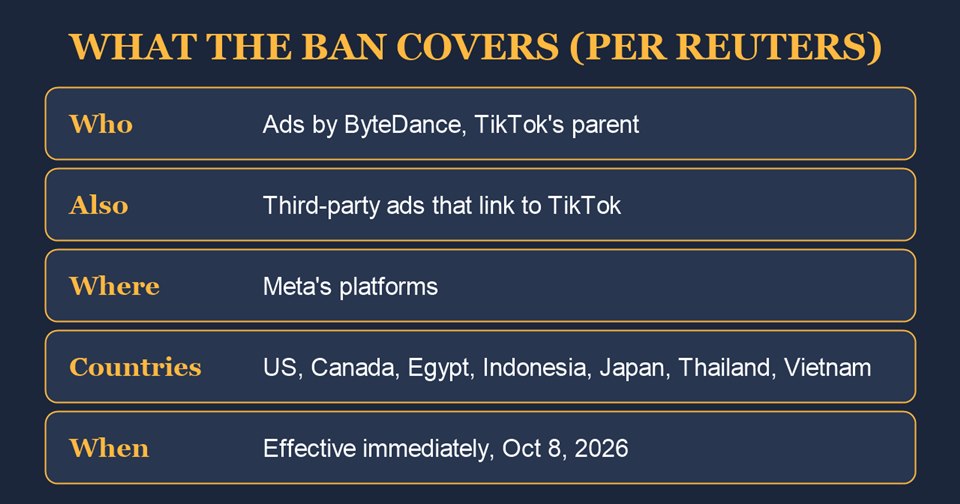
Meta bans TikTok ads: on October 8, 2026, a Meta spokesperson confirmed that Facebook and Instagram’s parent company has banned advertisements by ByteDance, TikTok’s Chinese parent, in the United States and six other countries. The ban takes effect immediately and also reaches third-party advertisers whose campaigns link to TikTok or other ByteDance properties. This guide to why Meta bans TikTok ads lays out what Meta said, what the ban covers and what the reports do not say.
Everything below comes from Reuters’ report, republished by The Star, with details checked against Music Business Worldwide and The Next Web. According to Reuters, Bloomberg News first reported the ban the same day.
What to know:
- What happened: Meta bans TikTok ads from ByteDance on its platforms, per a Meta spokesperson quoted by Reuters.
- Where: the US, Canada, Egypt, Indonesia, Japan, Thailand and Vietnam.
- Who else is covered: third-party advertisers running campaigns that link to TikTok and other ByteDance properties in those countries.
- TikTok’s response: TikTok and ByteDance did not immediately respond to Reuters’ requests for comment.
In this article
What Meta Banned
Reuters reports that the Meta ban on TikTok ads takes effect immediately in seven countries: the United States, Canada, Egypt, Indonesia, Japan, Thailand and Vietnam. It applies to ads from ByteDance itself and, Meta said, extends to third-party advertisers that run campaigns linking to TikTok and other ByteDance properties in those countries.
Music Business Worldwide describes the same scope as blocking “all ads and paid marketing messages” from ByteDance across Meta’s platforms, plus campaigns from third-party advertisers that direct users in those markets to TikTok or other ByteDance-owned services. In practice, the ban on TikTok ads is aimed at paid promotion, so a brand that buys Facebook or Instagram ads to send people to its TikTok account is inside the rule as the sources describe it.
What Meta Said
In its statement, Meta said: “We don’t have to run ads from a competitor whose goal is to pull people off our apps.” It added: “Declining promotional services to a competitor is a normal business practice across industries. We will continue to compete on product quality and user experience.”
Reuters calls the move “an escalation in the long-running rivalry” between Meta and ByteDance, and describes TikTok as one of Meta’s most formidable competitors for user engagement, creators and advertising dollars. Meta’s statement frames the decision as a competitive one.
Timeline: How Meta Bans TikTok Ads Fits the Rivalry
- August 2026: Meta agrees to a settlement of up to $18 billion with US states over social media harms to children and commits to daily usage limits and restrictions on nighttime use, per Reuters.
- After August: Meta urges TikTok and YouTube to follow the same steps, per Reuters.
- September 2026: TikTok reaches its own settlement with Alabama, per Reuters.
- October 8, 2026: Meta bans ads by ByteDance, and ads linking to TikTok, in seven countries. Music Business Worldwide reports Meta began blocking the ads across its platforms that day.
The Rivalry Behind the Ban
Reuters ties the decision that Meta bans TikTok ads to a larger argument between the two companies. It reports that Meta has been urging TikTok and YouTube to follow teen-safety steps Meta agreed to in August, after a settlement of up to $18 billion with US states over social media harms to children. Those steps include daily usage limits and restrictions on nighttime use by children.
TikTok has not publicly commented on Meta’s campaign, per Reuters, though it reached its own settlement with Alabama in September that requires new usage limits and age-verification measures for users in that state. This site covered that deal in the Alabama settlement breakdown, and the wider September legal picture in TikTok Child Safety: Three Separate Tracks.
One more detail from Reuters: TikTok’s own website says it does not support links that open or log users into other social media apps, although users can still add links to their profiles that point to those platforms’ websites. Reuters also notes that TikTok operates in the US as a majority American-owned joint venture, serving more than 200 million users.
What Meta Bans TikTok Ads Means for Advertisers
The sources describe the scope in terms of ads and campaigns, so the plainest reading is practical. In the seven named countries, an advertiser cannot buy Facebook or Instagram placements that send people to TikTok or another ByteDance property, per the reports. Outside those seven countries, the reports do not describe any restriction.
For creators and brands, the headline question is whether the rule that Meta bans TikTok ads changes anything about ordinary posting. The reports do not say it does. They describe paid promotion only, and The Next Web states plainly that the ban does not stop people from using TikTok.
Advertisers who run campaigns on both platforms will want to read Meta’s own advertising policies for the exact wording. This guide only reports what Meta told Reuters and what the three outlets above published.
What the Ban Does Not Say
- Enforcement: the reports do not explain how Meta will detect which third-party ads link to TikTok.
- Scale: none of the sources says how many advertisers or how much ad spending is affected.
- Organic posts: the coverage describes ads and paid marketing messages. It does not address ordinary, unpaid posts that mention or link to TikTok, so this guide makes no claim about them.
- TikTok’s side: as of the reports, TikTok and ByteDance had not responded, and TikTok has not commented on Meta’s campaign.
- Use of the app: The Next Web notes the ban does not stop people from using TikTok. It restricts advertising on Meta’s apps.
Frequently Asked Questions
Did Meta ban TikTok, or does Meta ban TikTok ads only?
Meta bans TikTok ads, not TikTok itself. Meta banned ads by ByteDance, TikTok’s parent, and third-party ads linking to TikTok, on its own platforms in seven countries. People can still use TikTok.
Which countries does the Meta ban on TikTok ads cover?
The United States, Canada, Egypt, Indonesia, Japan, Thailand and Vietnam, per Reuters.
Why did Meta ban TikTok ads?
Meta’s stated reason is that it does not have to run ads from a competitor whose goal is to pull people off its apps. Reuters reports the move follows a long-running rivalry and Meta’s campaign urging TikTok to adopt similar teen-safety steps.
Has TikTok responded?
Reuters reported that TikTok and ByteDance did not immediately respond, and that TikTok has not publicly commented on Meta’s campaign.
Sources: Reuters via The Star, Music Business Worldwide, The Next Web.